How an old visual-effects problem has become a new creative workflow for me, and what artists can learn from the studios that solved earlier versions of it.
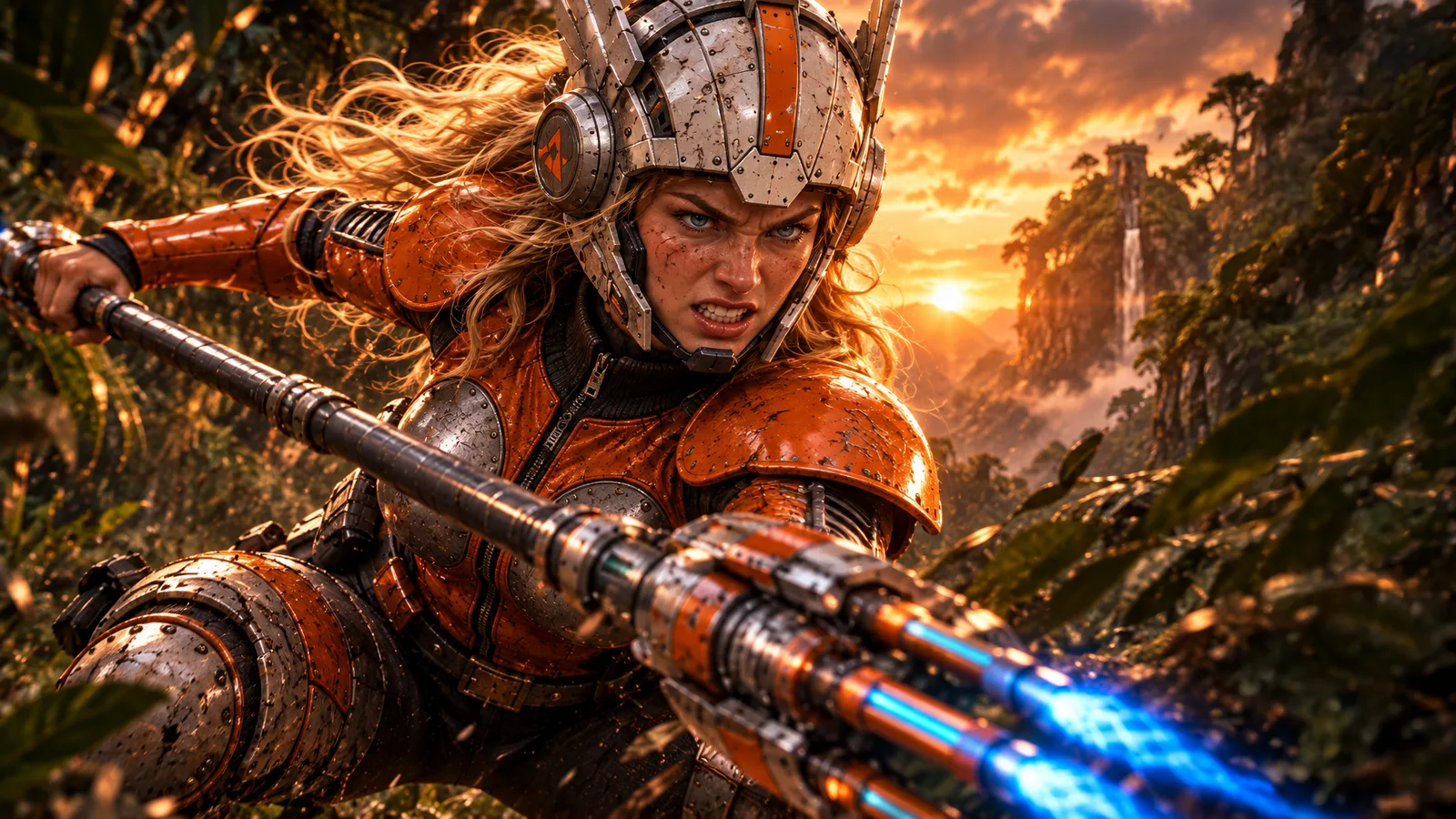
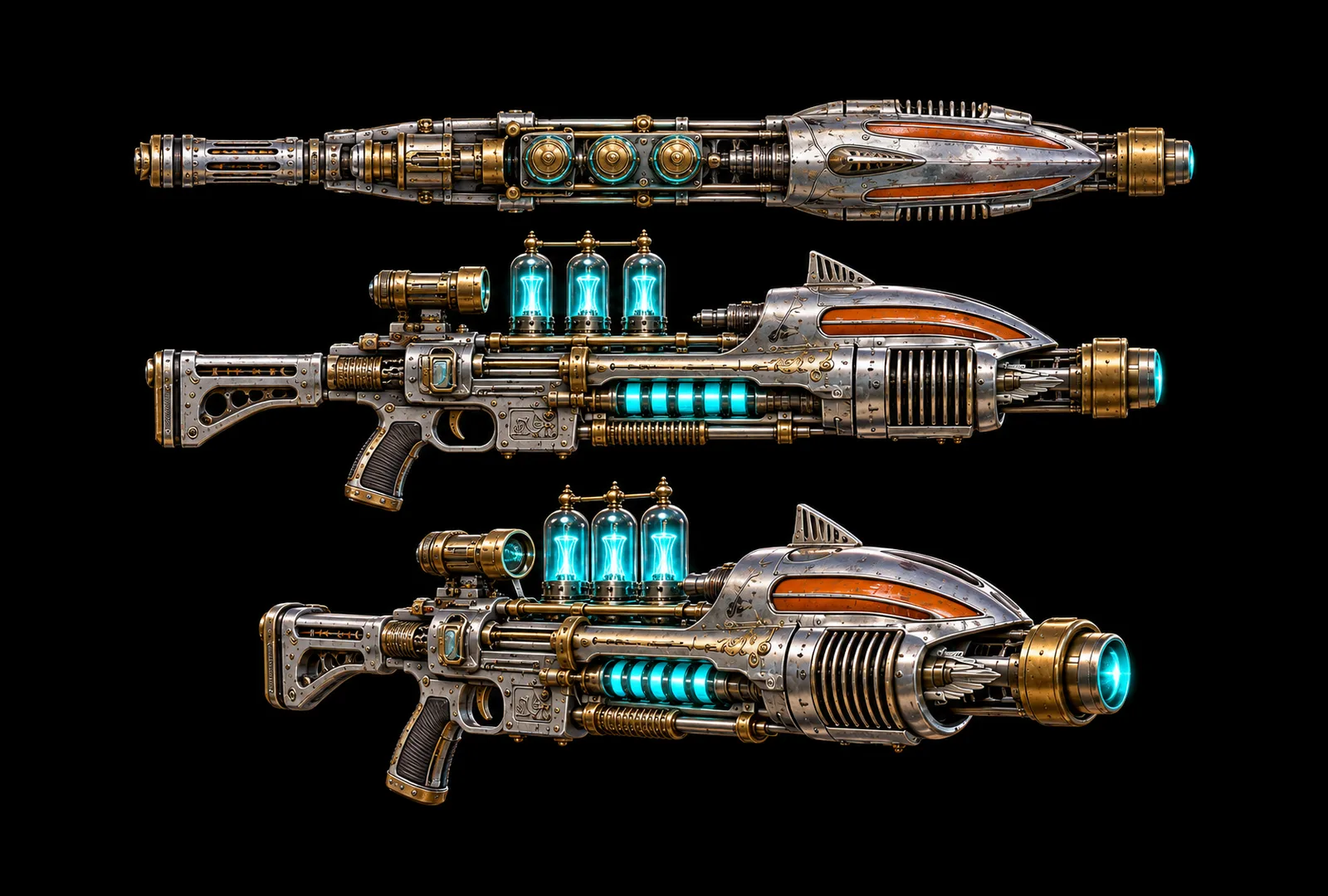
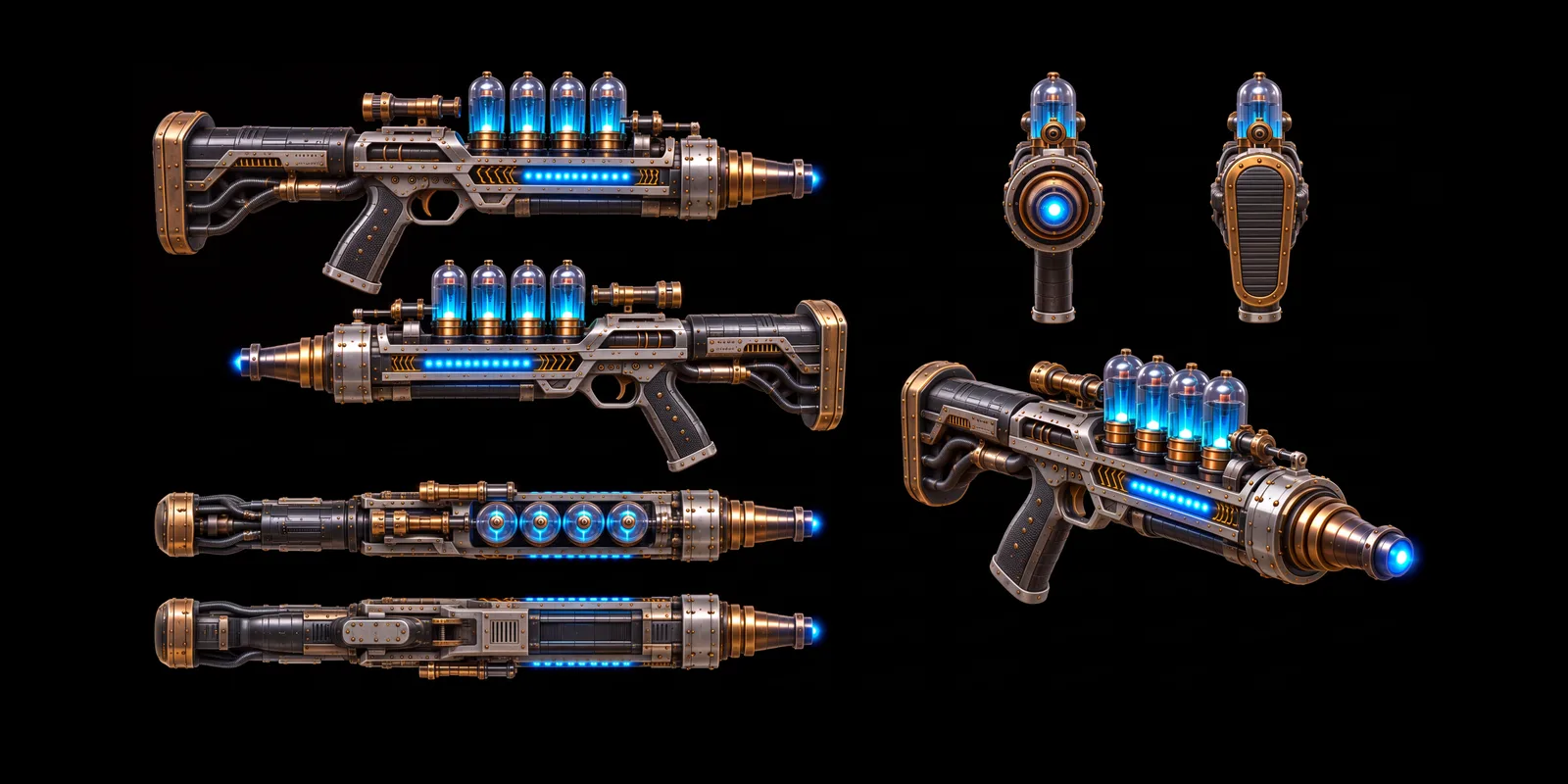
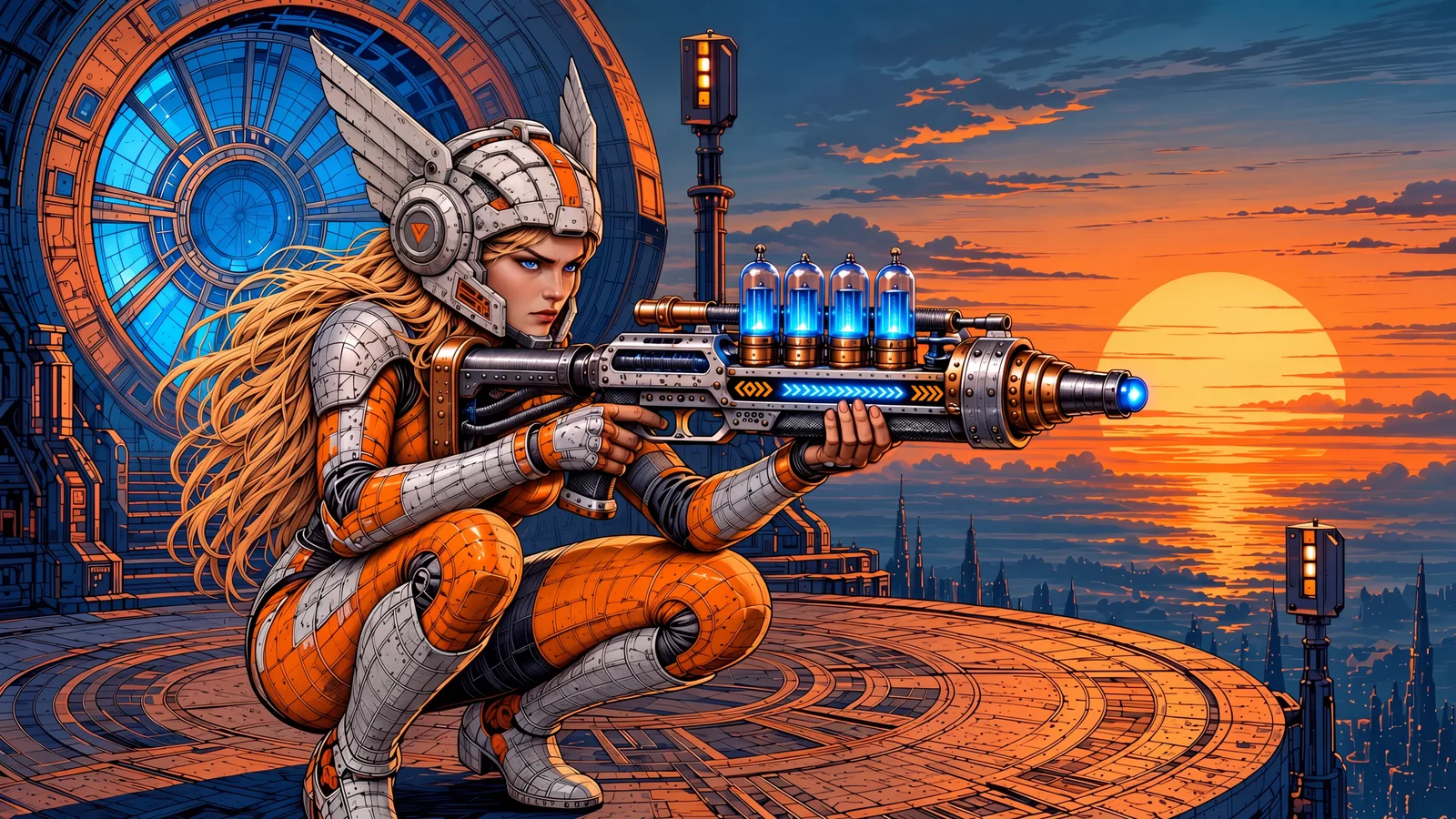
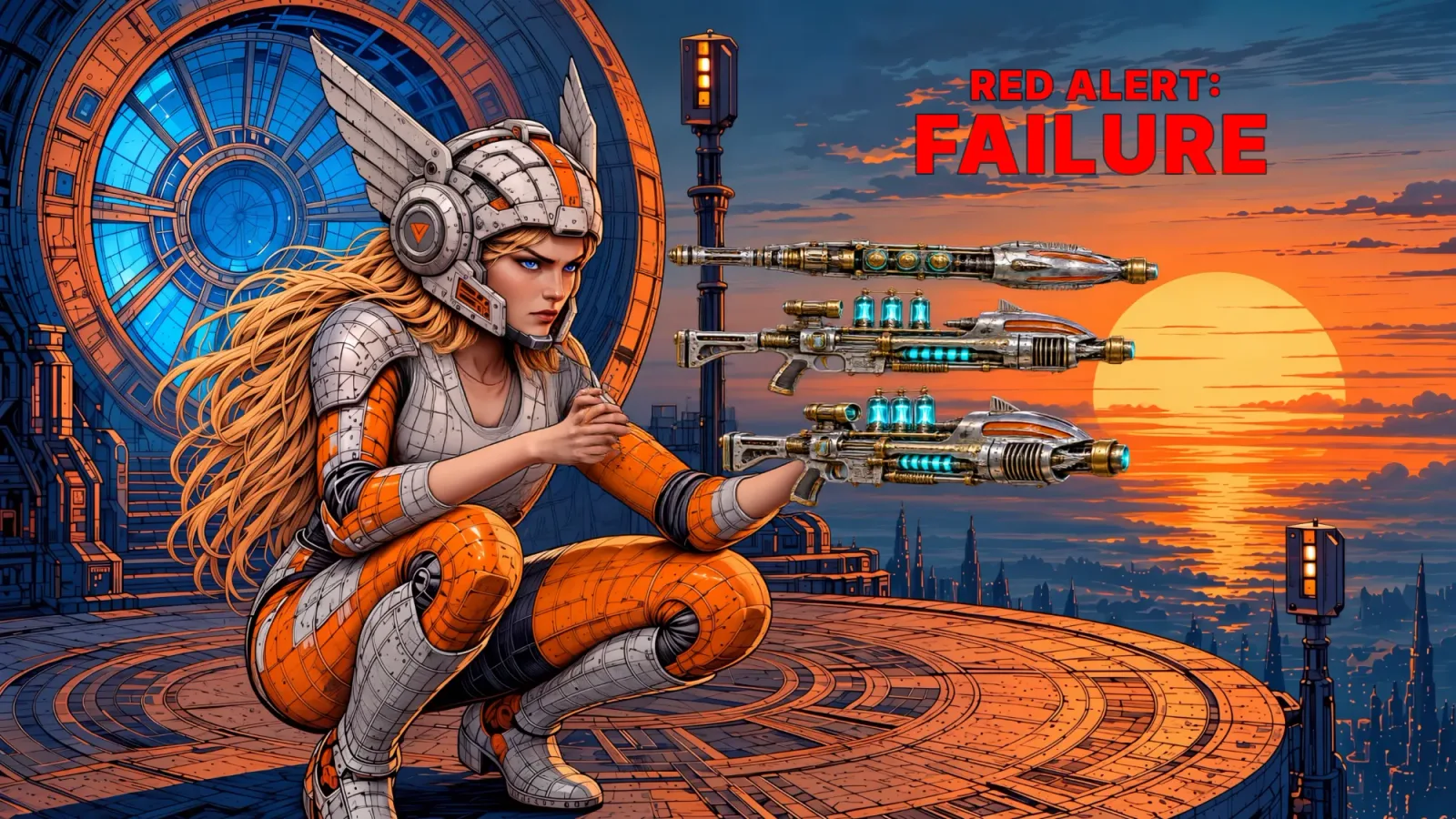
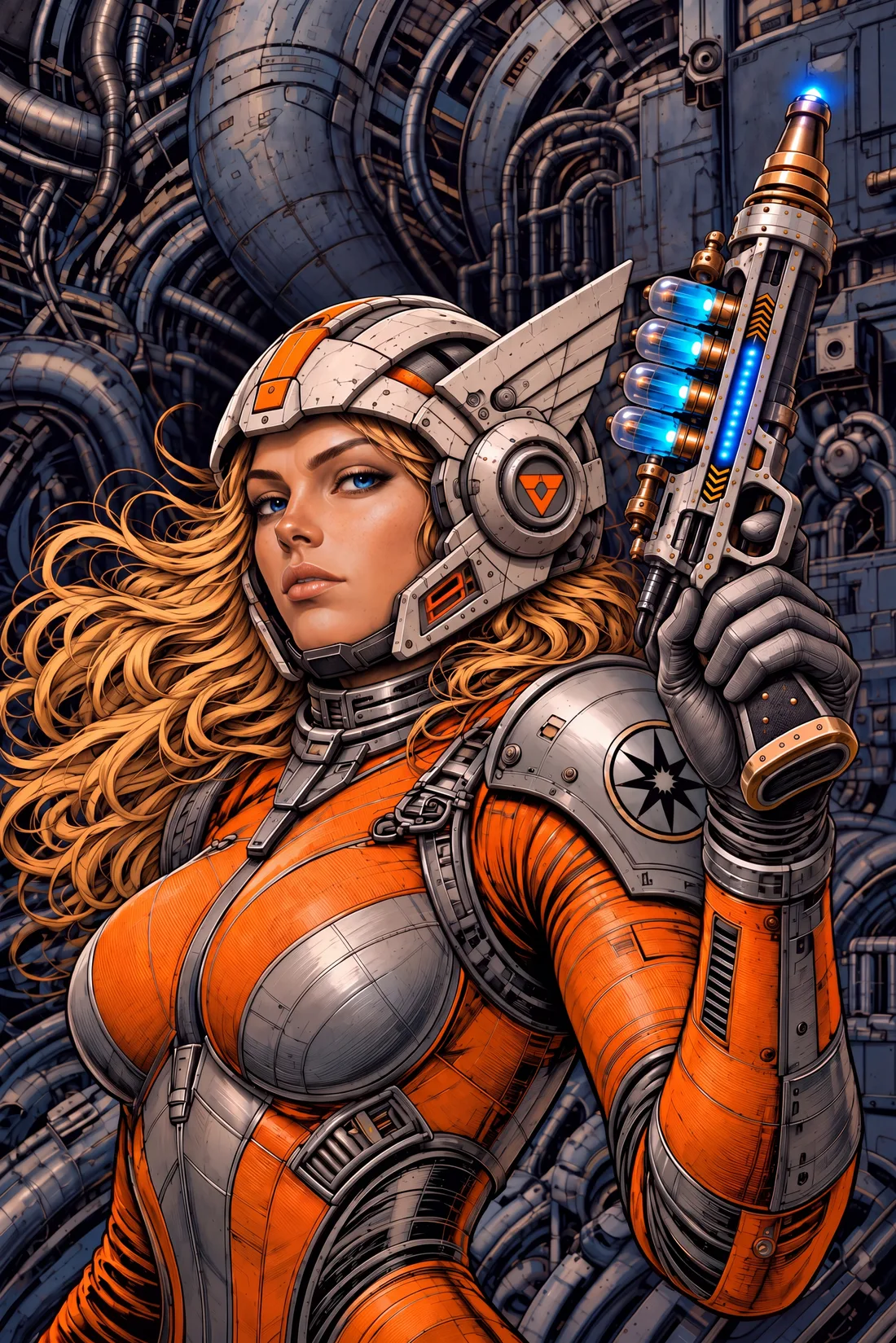
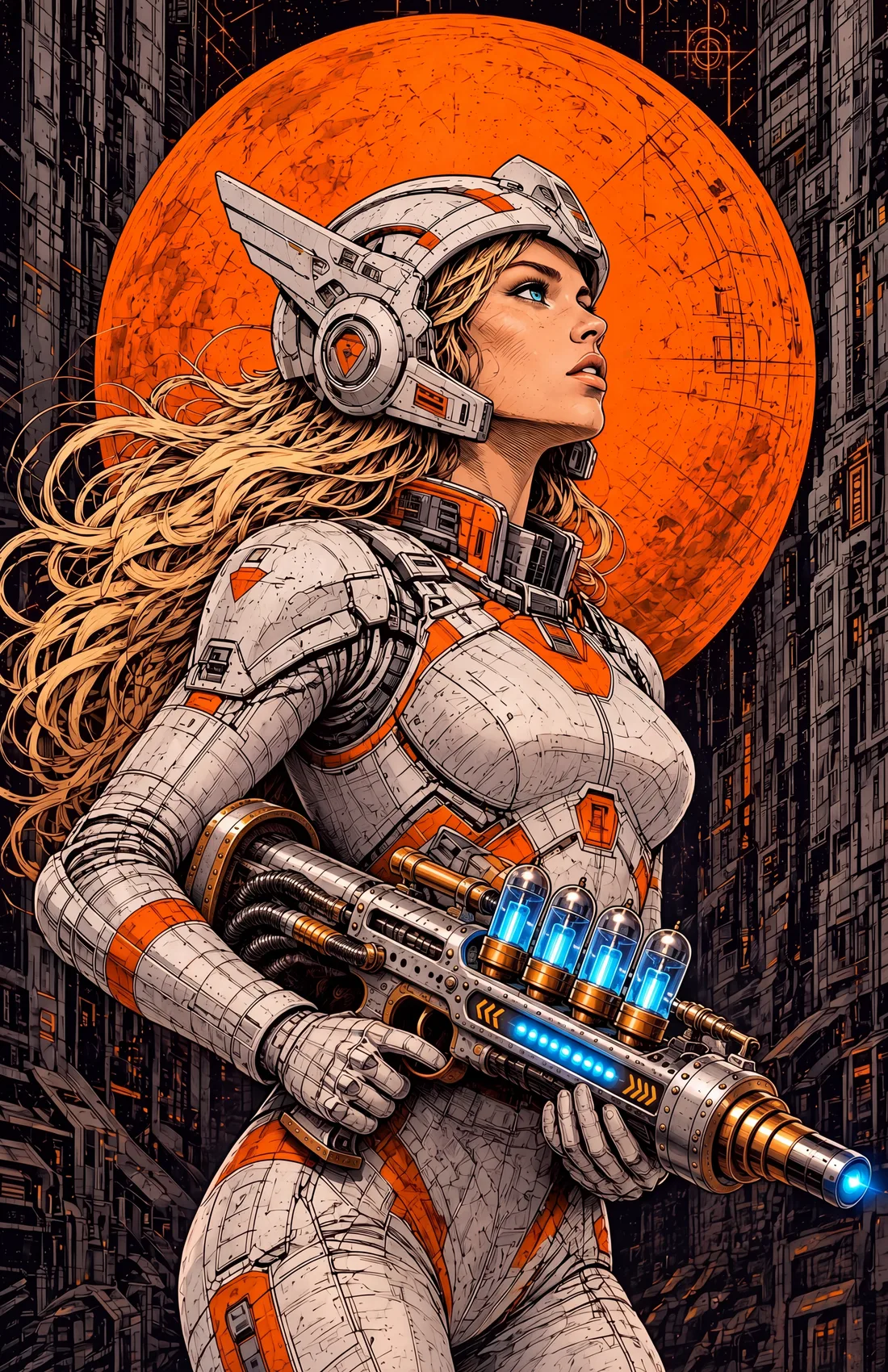
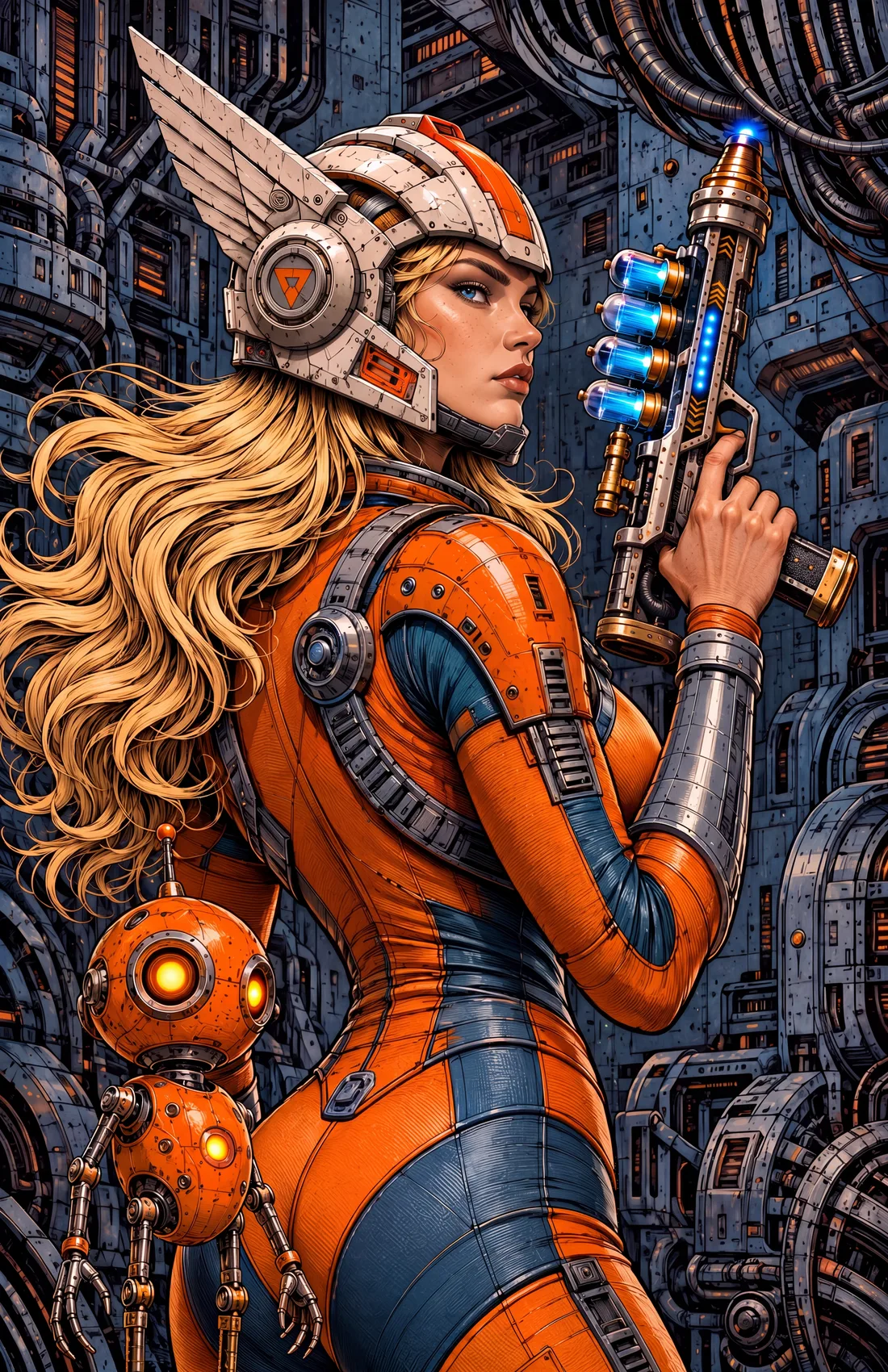
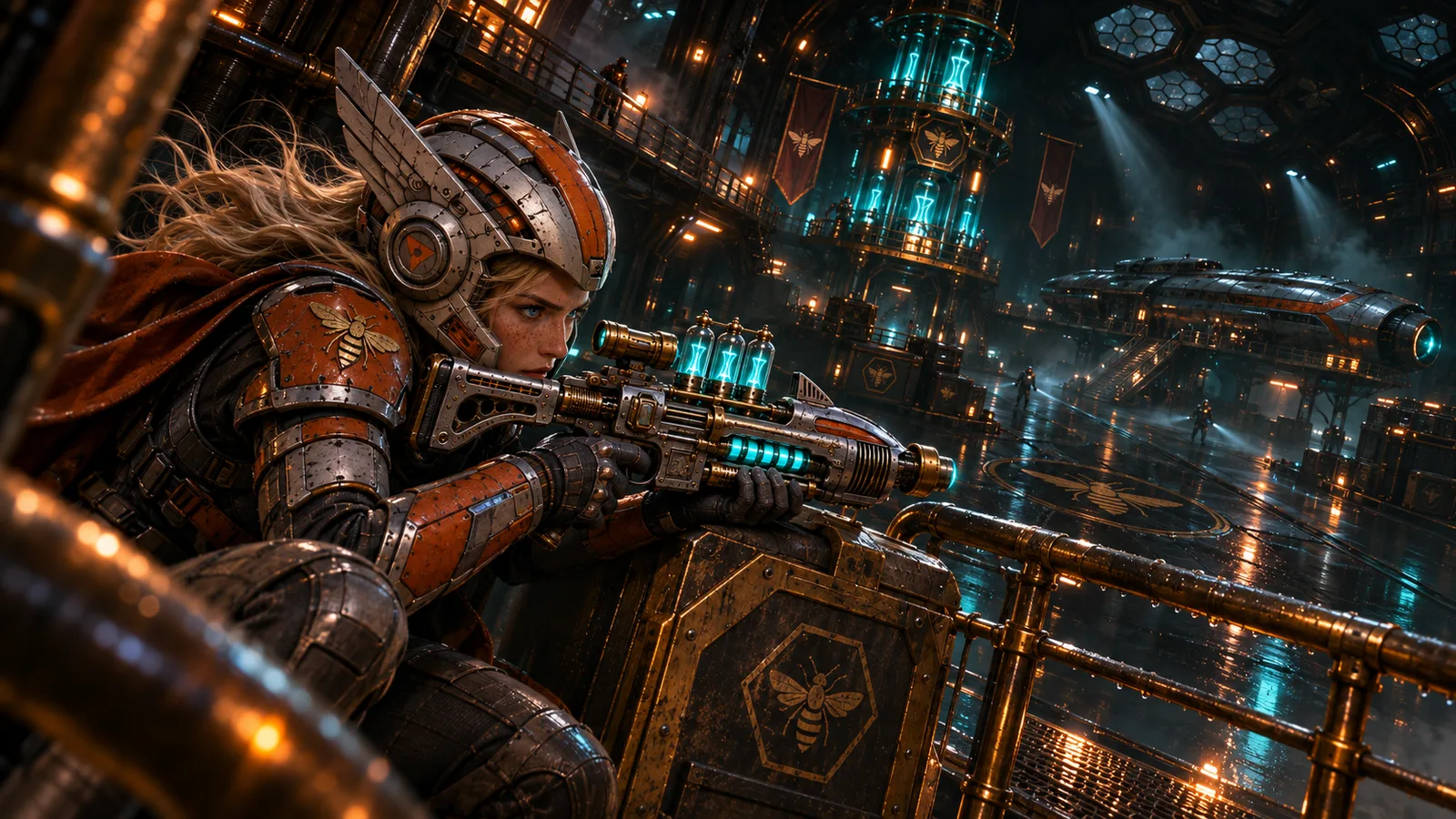
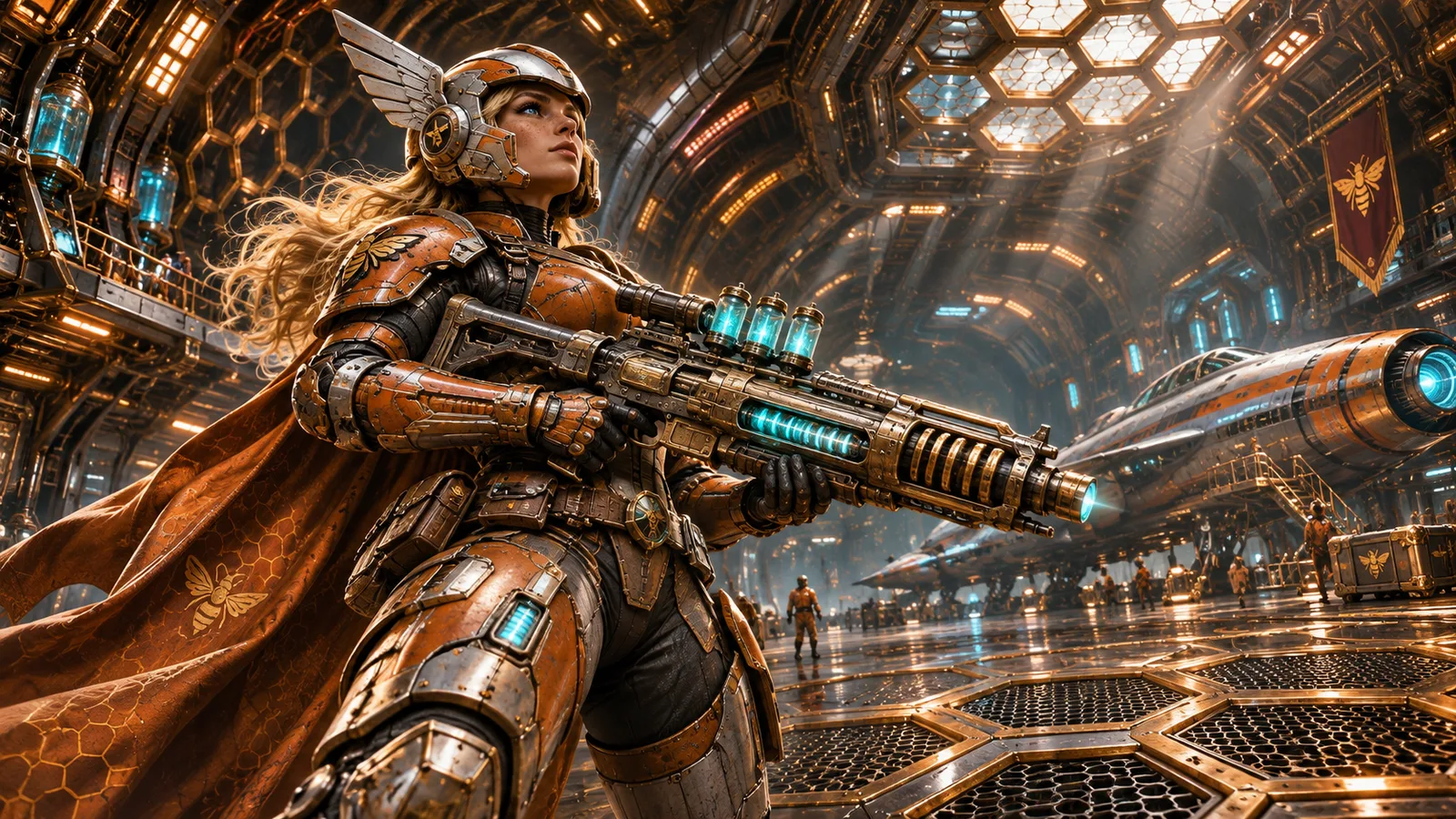
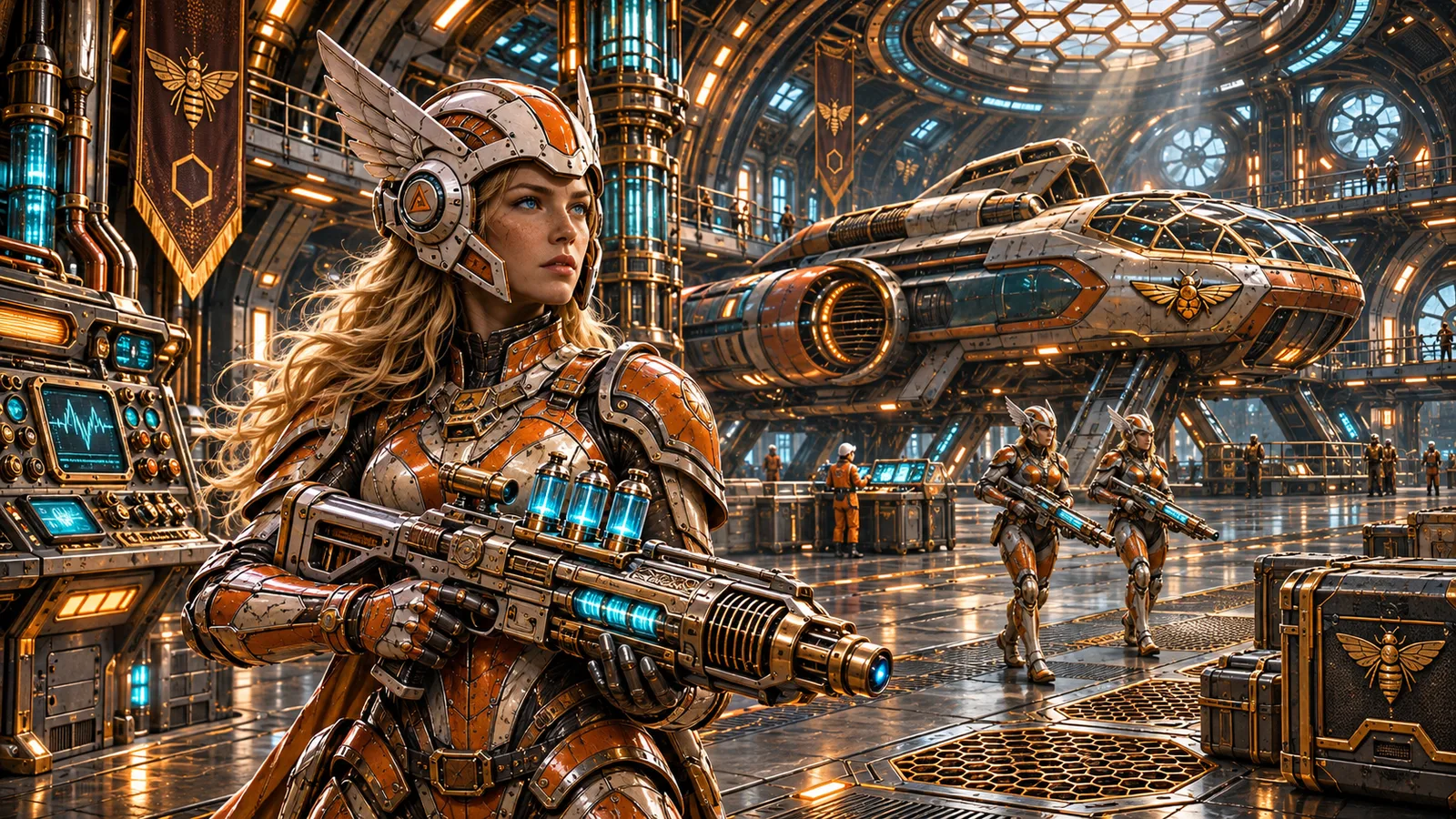
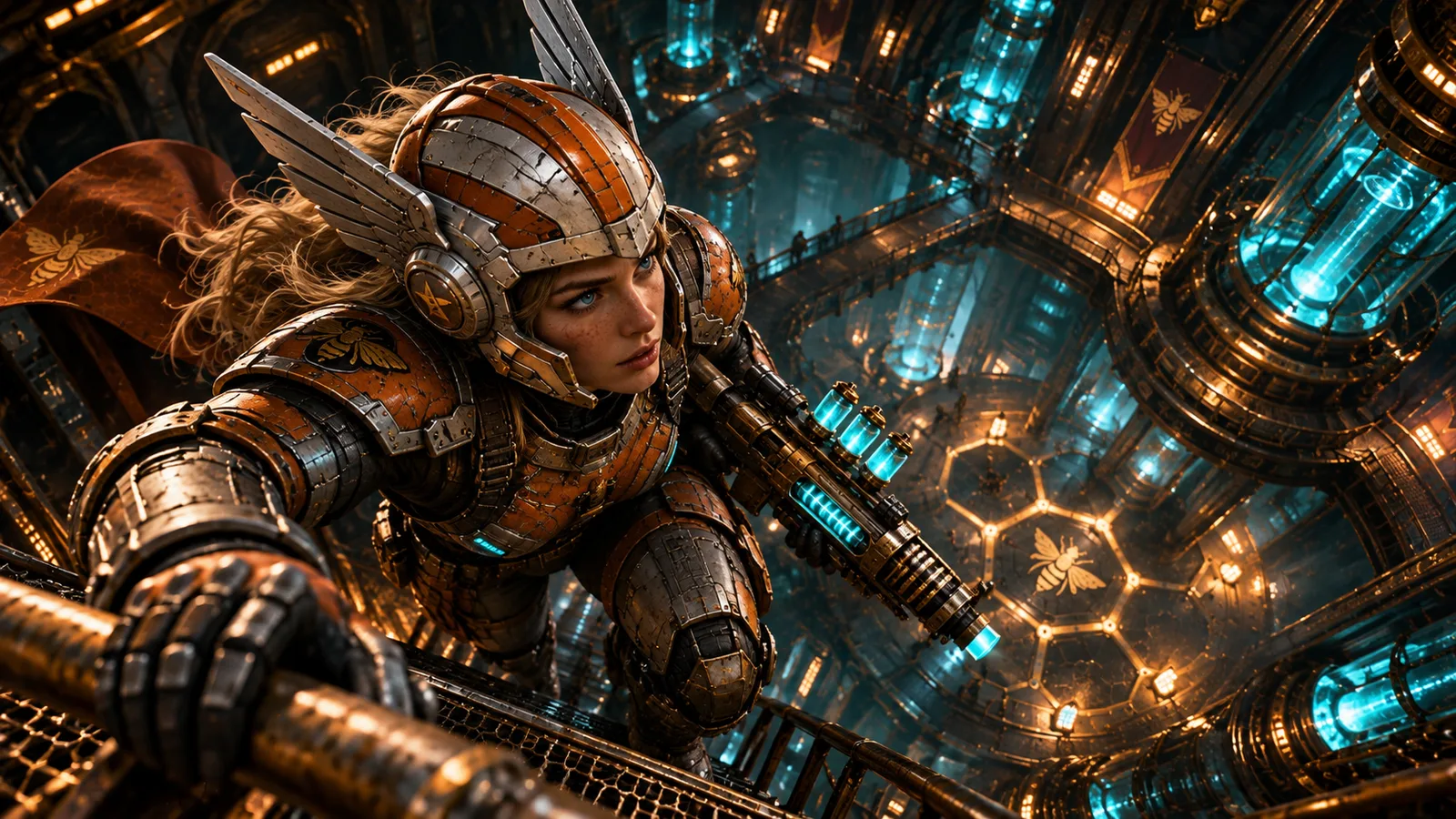
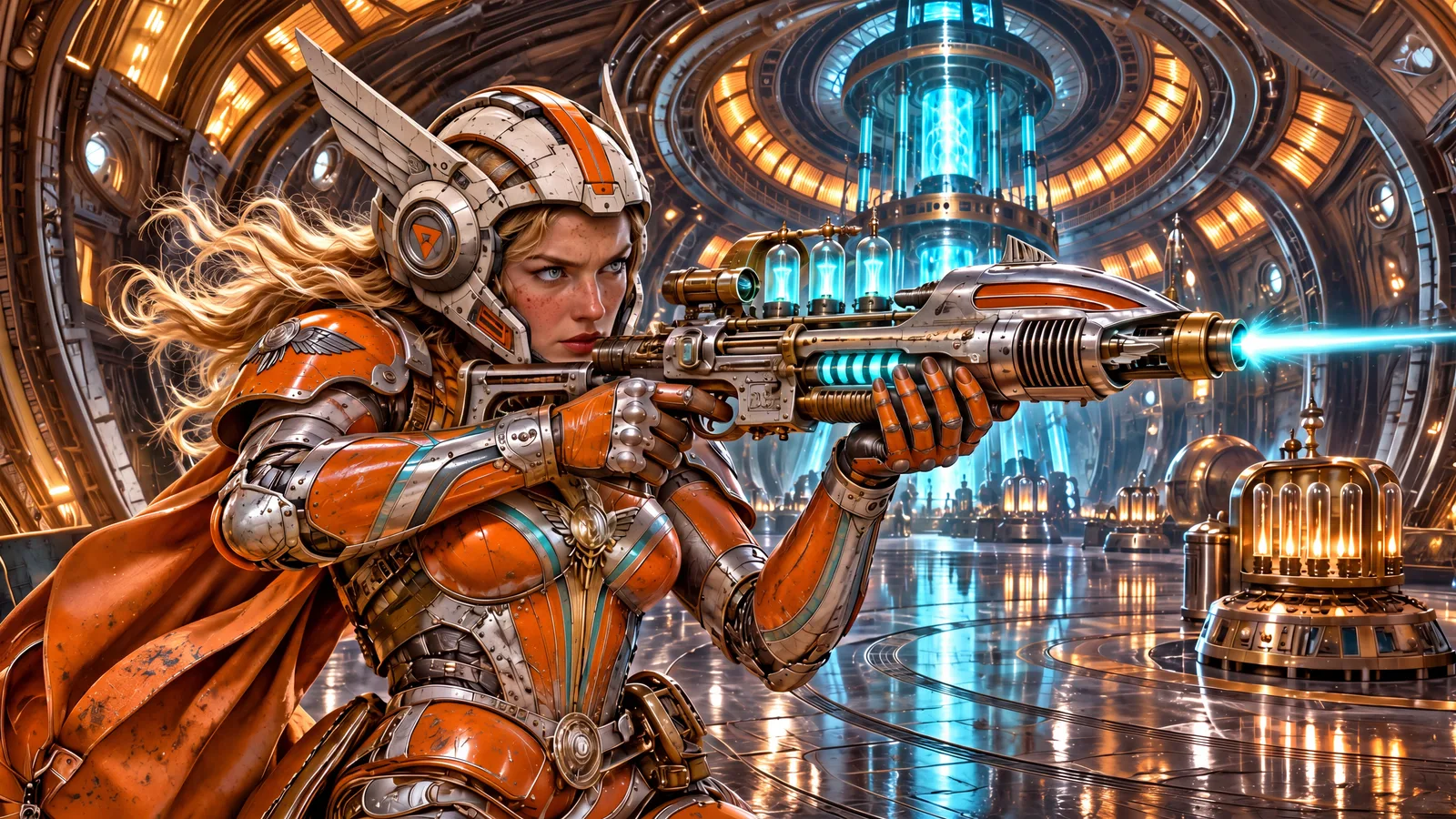
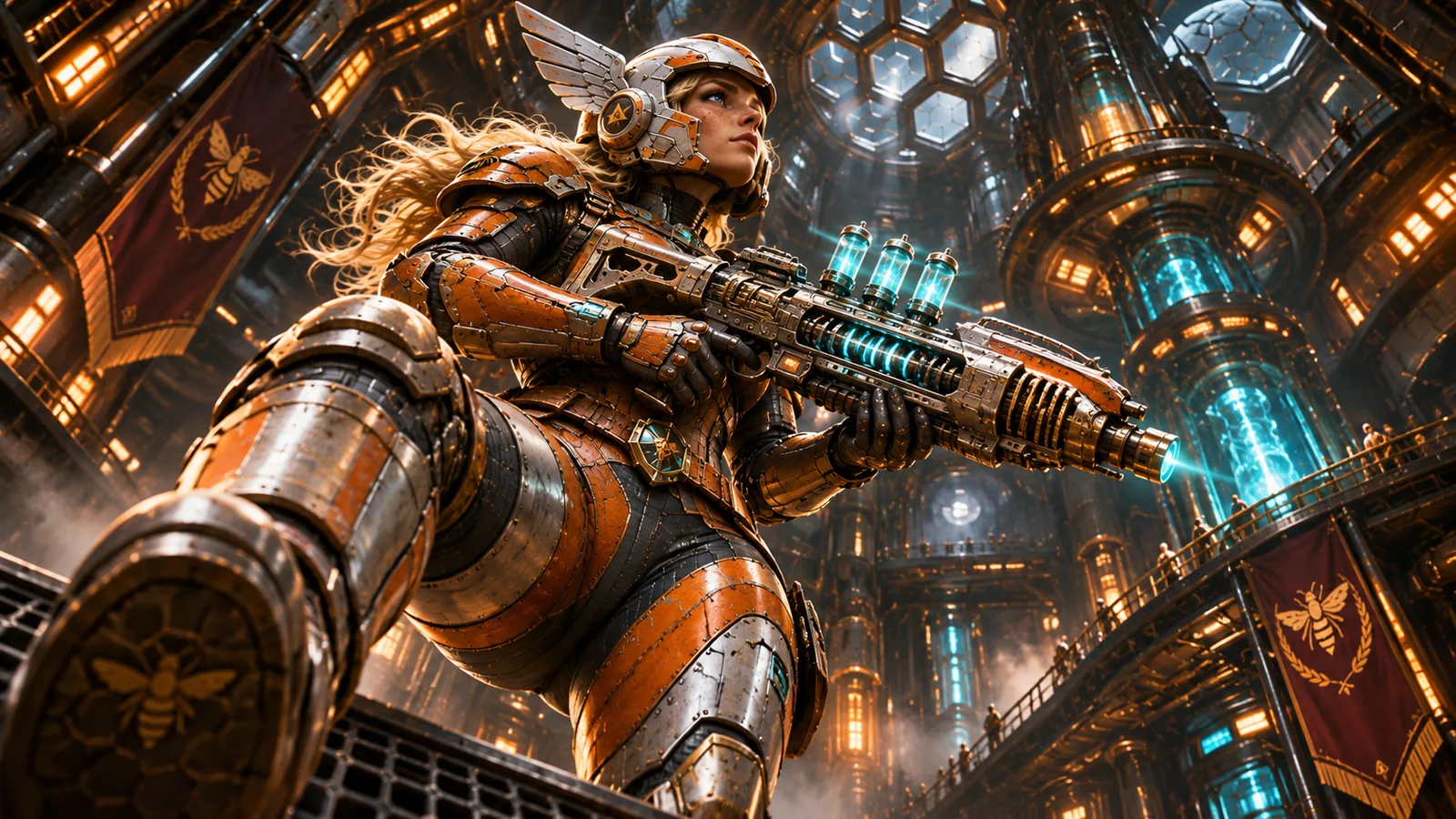
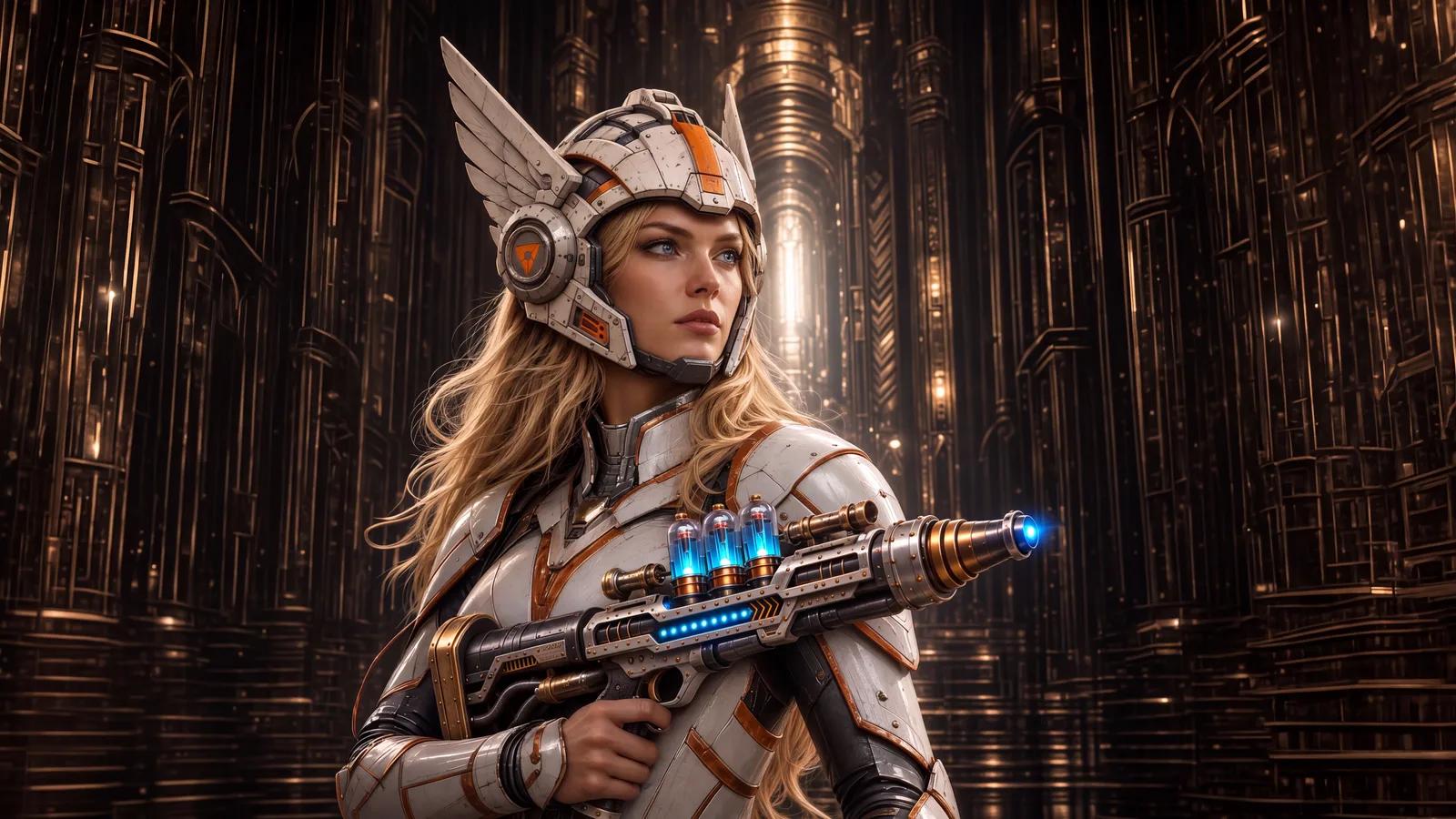
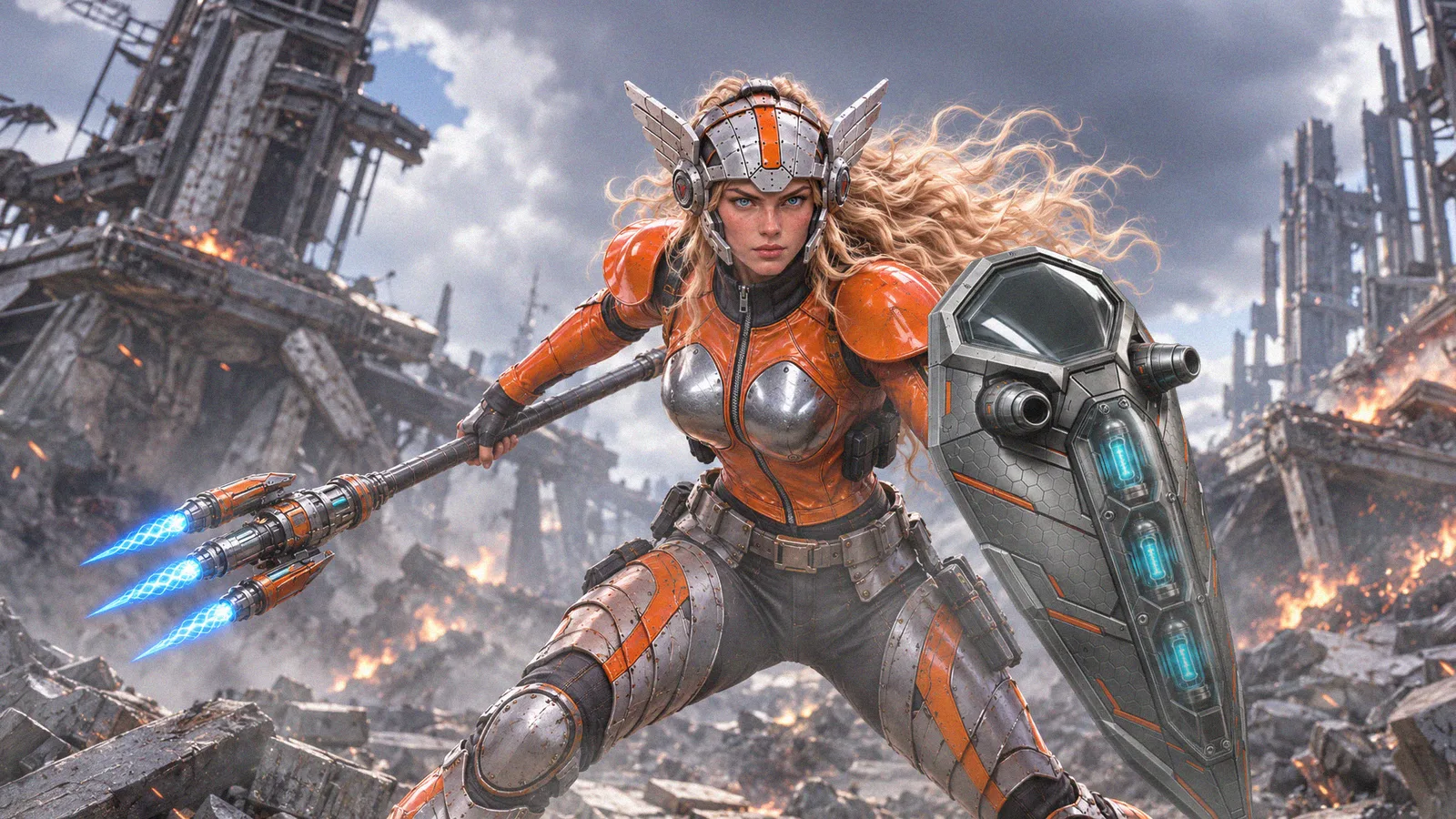
For an ongoing project, I have been building a series of science-fiction illustrations featuring Valkyrie troopers, a rather elaborate winged helmet, and an energy rifle I affectionately call the blue-tuber. The canonical version of the rifle has four bright cyan vacuum tubes, antique brass fittings, a gunmetal receiver, and enough retro-futurist hardware to suggest that its designer was trapped in an Art Deco machine shop for several happy years. It is a fictional object, but I’ve become particular about its construction. If it appears in twenty illustrations, I want it to look like the same rifle in all twenty. Uh oh.
That requirement led me into a surprisingly deep technical subject. With generative AI, I can upload an existing illustration, supply a multi-view reference of the blue-tuber, or any of the things in the scene that I have pre-designed elsewhere, and ask for the original prop to be replaced without changing the woman’s face, her pose, the architecture, or the composition. I’ve been doing something similar with her helmet, which now has its own model sheet. The process works often enough to be useful, but it is not infallible. Sometimes the rifle grows an entirely new muzzle. Sometimes a vertical row of tubes is invented where it shouldn’t be. Sometimes a perfectly good composition comes back with the camera apparently moved six feet to the left.
The general technique is object replacement. More specifically, my workflow is reference-guided, style-constrained prop replacement. When a selected region is regenerated from surrounding pixels and reference material, the relevant term is reference-guided inpainting. These descriptions overlap, but they are not interchangeable. Compositing, masking, inpainting, and maintaining a canonical asset are related practices with different histories and different kinds of control.
What interests me most is that this apparently futuristic exercise belongs to a much older artistic tradition: the effort to change one part of an image without losing the integrity of the whole.
Before computers: the image was already a construction
Cinema did not begin as the straightforward recording of things that were actually in front of a camera. From early on, filmmakers combined real and fabricated elements to depict places and events that could not be photographed together. One important method was matte painting. An artist could paint a palace, a cliff, or the upper floors of an enormous building, leaving an area through which live action remained visible. Glass paintings and later photographic and optical techniques allowed filmmakers to expand sets without constructing them in full. Norman Dawn’s early twentieth-century glass-shot work is a familiar milestone in this history.
What mattered was not merely painting a convincing building. The painting had to agree with the photographed scene about perspective, lighting, scale, and where the camera appeared to be. If those relationships failed, the audience noticed the join. The same principle holds when I insert a blue-tuber into a heroine’s hands: an attractive replacement object is useless if it doesn’t belong to the image’s geometry.
Optical printing made combinations more flexible. By rephotographing film elements and using mattes to control where one image appeared over another, effects artists could assemble imagery from separately photographed material. Linwood Dunn became one of the important practitioners of this craft, including work associated with King Kong (1933) and Citizen Kane (1941). Traveling mattes extended the process to moving subjects, a major step beyond the simplest locked-off, static effects. These methods were laborious, and every element had to be managed through the photographic properties of film.
The original Star Wars films offer a memorable illustration of the pre-digital accomplishment. Matte paintings, miniature photography, blue-screen work, and optical compositing all contributed to environments and action that audiences experienced as unified places. The technology was different from today’s tools, but the artistic problem was familiar: many independently created things had to appear to occupy a single coherent world.
It is tempting to describe today’s AI object replacement as a direct descendant of any one of these techniques. The more accurate claim is that it inherits their problem. The method of generating pixels is different, but the need to make an alteration visually belong to an existing image is the same.
An equally important ancestor: the animation model sheet
There’s another historical line that matters even more when the goal is a recurring prop or character: the model sheet.
Imagine a film animated by dozens of artists. Each artist understands the character slightly differently, and without shared references the hero’s nose, helmet, costume, or proportions drift from scene to scene. Studios developed approved drawings showing characters from different angles, with characteristic poses and expressions, to establish what should remain consistent. Disney’s Character Model Department, active from 1937 to 1941, developed and distributed such references and physical maquettes, especially as feature animation demanded increasingly coordinated work.
This is precisely why I made separate multi-view sheets for the blue-tuber and the Valkyrie helmet. A beautiful image of the rifle from a single angle is not enough. I need front, side, rear, top, and three-quarter views so that the object has an identity independent of one illustration. A model sheet is not merely documentation after the design is finished. It can also be a way of discovering whether the design is coherent.
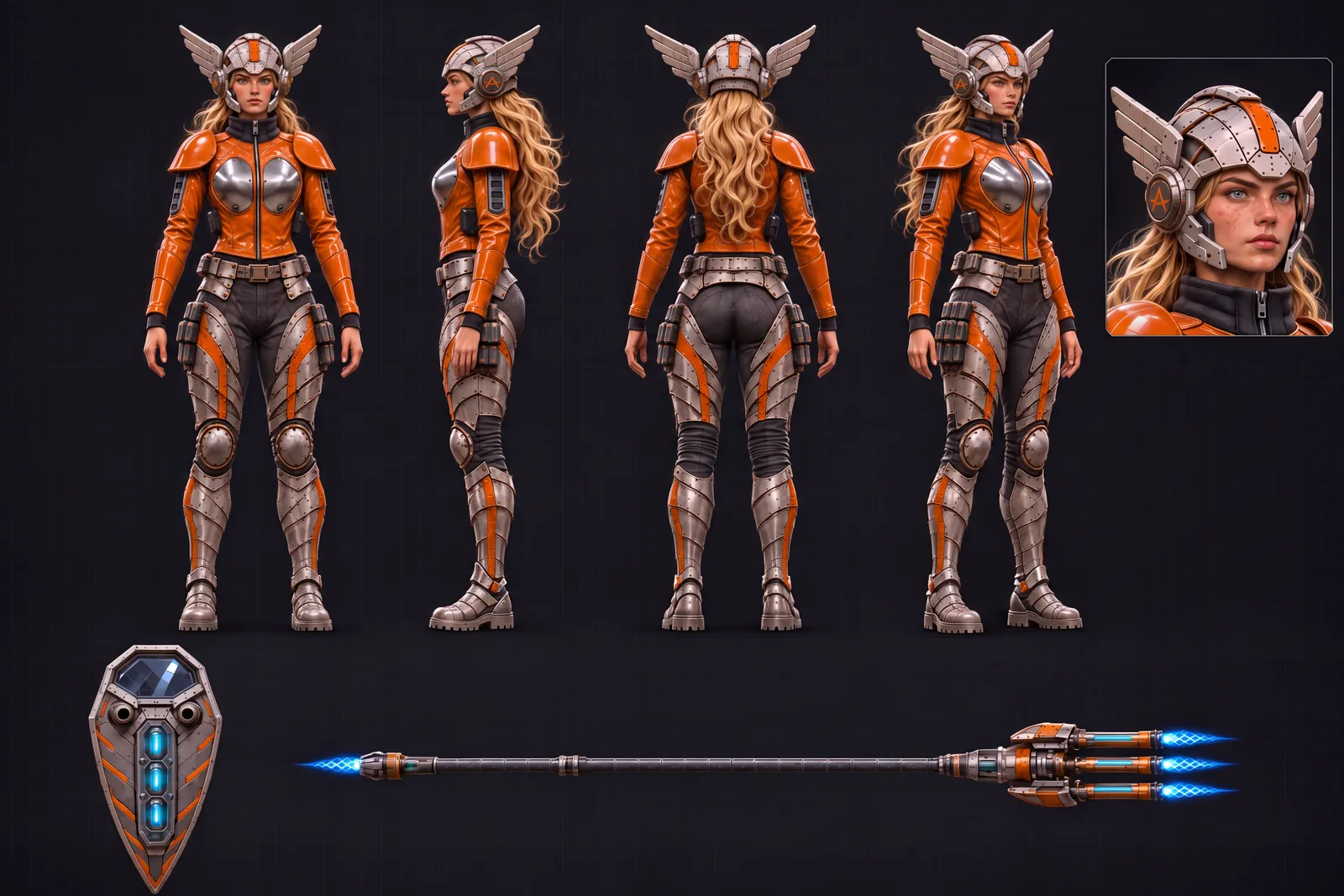
I went a step further and broke individual costume pieces out into their own turnaround sheets, the same way a studio would separate a prop from the character wearing it.
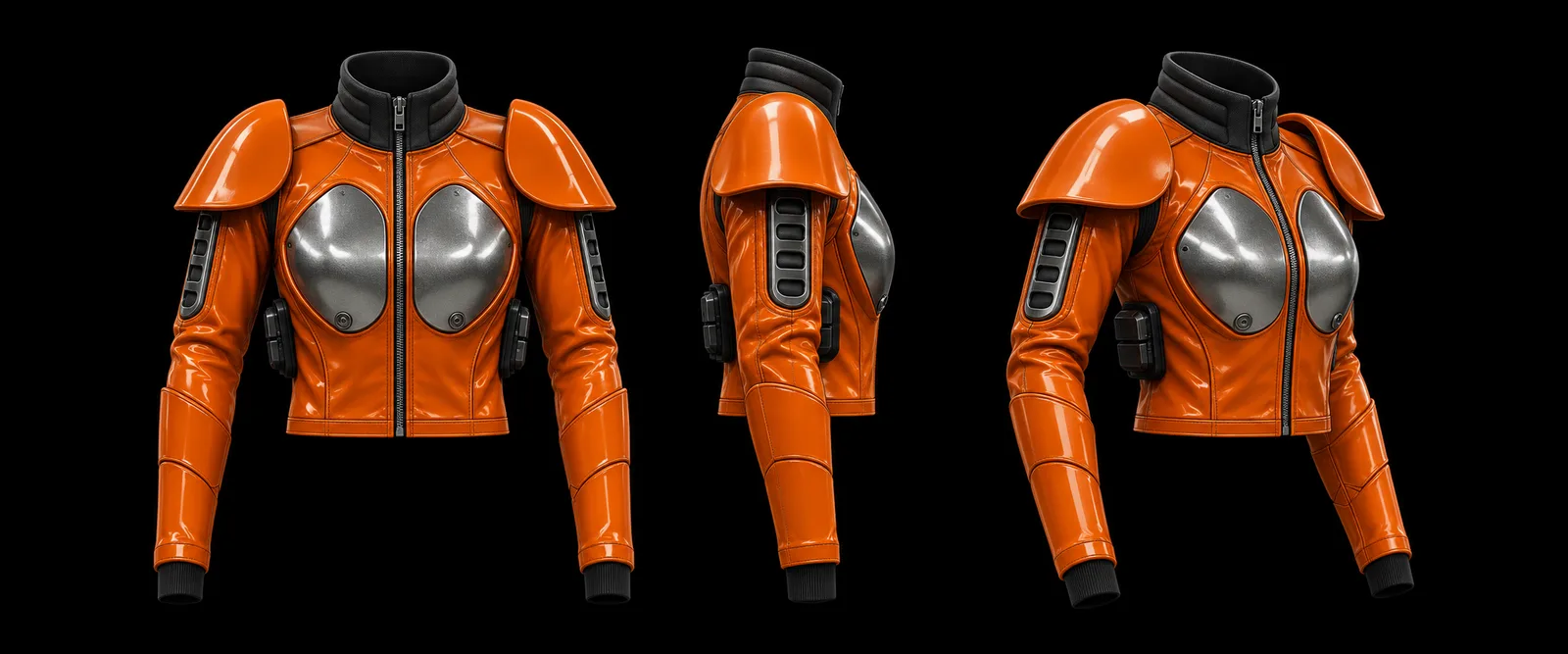
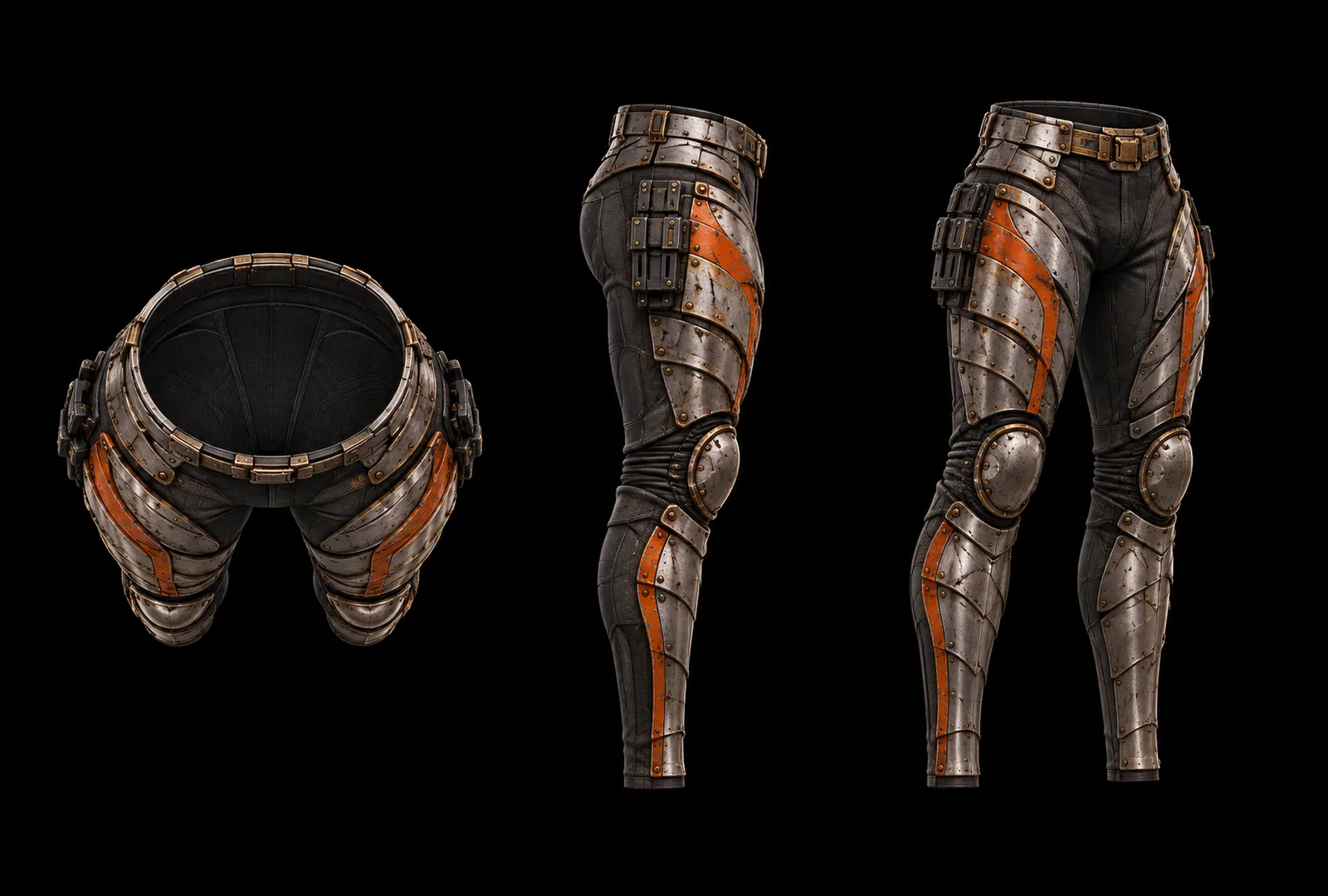
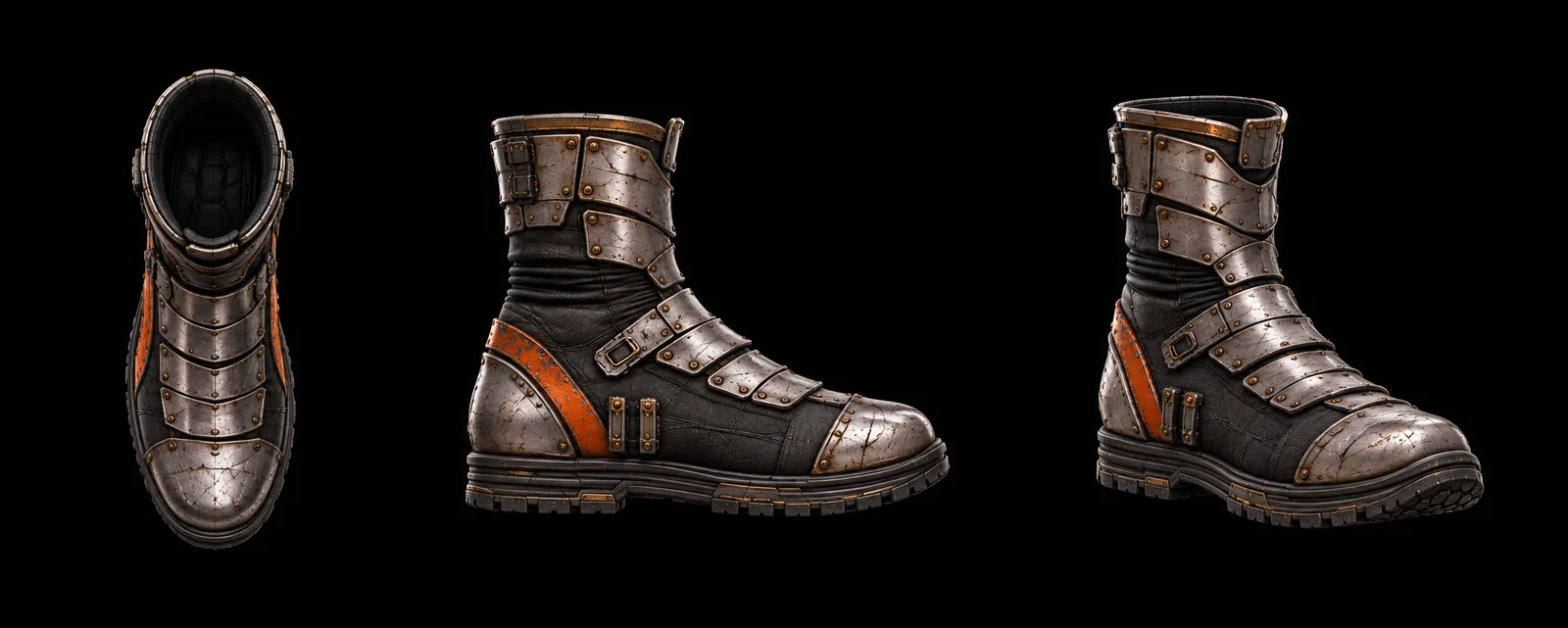
The animation connection supplies a particularly useful distinction: style and identity are not the same thing. The same character can be drawn in a loose sketch, an inked comic panel, or a polished painted frame. Yet certain relationships of shape, proportion, and detail must survive. For my blue-tuber, the rendering may change from glossy photorealism to aggressively hatched 1970s science-fiction illustration. The essential object should not. It’s been a real challenge learning about this stuff and attempting to do it.
Digital compositing: precise control becomes practical
Digital image-making gradually gave artists more direct control over these operations. Instead of repeatedly exposing film, a compositor could isolate an object with a mask or matte, track its motion, replace it, and adjust the result with editable layers or nodes. The alpha channel, which expresses how a pixel contributes to a composite, became fundamental to this way of working. Alvy Ray Smith’s historical account is especially useful for understanding how sophisticated digital compositing differs from simply pasting one rectangle of pixels on another.
A conventional visual-effects replacement may involve rotoscoping (drawing or refining a mask around a subject), camera or object tracking, removal of the original element, rendering or inserting the replacement, and then matching lighting, grain, motion blur, depth of field, and occlusion. A character’s fingers may need to pass in front of the replacement rifle while part of the rifle passes behind her forearm. That tiny spatial detail makes the difference between something convincingly held and something apparently glued onto the picture.
Traditional compositing has an advantage that becomes obvious after a few AI experiments: it can be highly local. A carefully managed mask can keep most of the source pixels untouched. Photoshop layers, for example, are particularly useful when the image is a still. Node-based compositing systems can make the same logic reproducible across many moving frames. This does not make compositing effortless; it makes the changes more inspectable and controllable.
For a perfectly stable recurring prop, a 3D model offers another advantage. A model can be rotated into the proper orientation and rendered with consistent structure. Generative AI may correctly infer much of an object from a reference image, but it is not automatically maintaining a mathematically fixed three-dimensional model behind the scenes. That being said, I’ve been shocked over the past few weeks at how accurate it can be, though coaxing it out of various agents can be frustrating as they’re not all the same. I became bewildered at how easily I would lose track of which agent was handling what, constantly opening Adobe Firefly when I meant to open ChatGPT, and so forth. I had elements cooking all over the place, and file management is not really something I’ve ever been consistently good at.
How studios think about reusable assets
Large studios generally cannot afford to treat every shot as a completely independent artistic invention. Characters, costumes, vehicles, environments, textures, and effects need to survive transitions between departments and repeated revisions. A simplified production path might begin with concept art and approved model sheets, move through modeling and look development, continue through rigging, layout, animation, and lighting, and finish with rendering and compositing. Not every studio, project, or effect follows this sequence, but the broad distinction between building an asset and using it in a shot is essential.
Pixar offers a particularly well-documented example. Its Universal Scene Description, or OpenUSD, was developed to let many applications and artists assemble, reference, and non-destructively override components of complex 3D scenes. Pixar describes USD as central to its production pipeline, and the project’s technical documentation explains how references, layers, and composition let teams work on the same virtual world without every department constantly rewriting one monolithic file.
That is a much larger and more rigorous version of a principle I’ve stumbled into with my own pictures. Establish the rifle once. Give it a stable identity. Let different scenes use it. If the production needs a new variant, identify that variant explicitly instead of accidentally turning the original into something else. Then, of course, when I learned how to do it, I had to go and introduce a second rifle with even more Art Deco flair. It’s an addiction.
Industrial Light & Magic documents another side of this process. Its Virtual Art Department builds and evaluates digital environments, including work in Unreal Engine, and helps teams decide what to construct physically and what to realize digitally. ILM’s StageCraft system ties virtual environments and production planning to on-set filmmaking. These public descriptions do not prove that ILM uses a particular AI inpainting procedure for prop swaps. They do demonstrate how major productions depend on reusable digital assets, coordinated design decisions, and controlled handoffs between artists and technical departments.
Studios also use digital doubles, set extensions, creature replacements, vehicle additions, costume enhancements, and entirely synthetic environments. The details are shot-dependent. A production may choose a physical hero prop for close-ups, a simplified stunt version for dangerous action, and a digital version for shots where the object needs to do something impossible. The audience should recognize one object even though several production methods helped bring it to the screen.
What AI changes, and what it doesn’t
Generative tools have made one portion of this work approachable for artists without a studio-sized pipeline. Adobe, for example, documents a Photoshop Generative Fill workflow in which a user selects an area, supplies a reference image, and specifies whether to swap an existing object or place a new object into the selection. The interface’s terminology is strikingly close to the work I’m describing. Being able to extend a square image to a more cinematic aspect ratio, and have it look flawless, has been a life-changer for me.
In a typical reference-guided edit, the source image supplies the scene and the replacement reference supplies the intended object. The model then generates a plausible result that fits the requested change. The word plausible deserves emphasis. Plausibility is not the same as dimensional accuracy, faithful product reproduction, or preservation of all unselected pixels.
A model can create a wonderfully lit sci-fi weapon with four blue glowing tubes and still get the weapon wrong. It may omit a distinctive stock detail, make the receiver much thicker, or substitute a row of neon arrows for the original discrete LED lamps. When the next edit uses this altered result as its reference, the changes can compound. This is design drift. It is not necessarily a formal diagnosis of a particular model’s internal behavior; it is a practical description of what an artist observes over successive generations. It happened to me a lot, often after only three or four iterations.
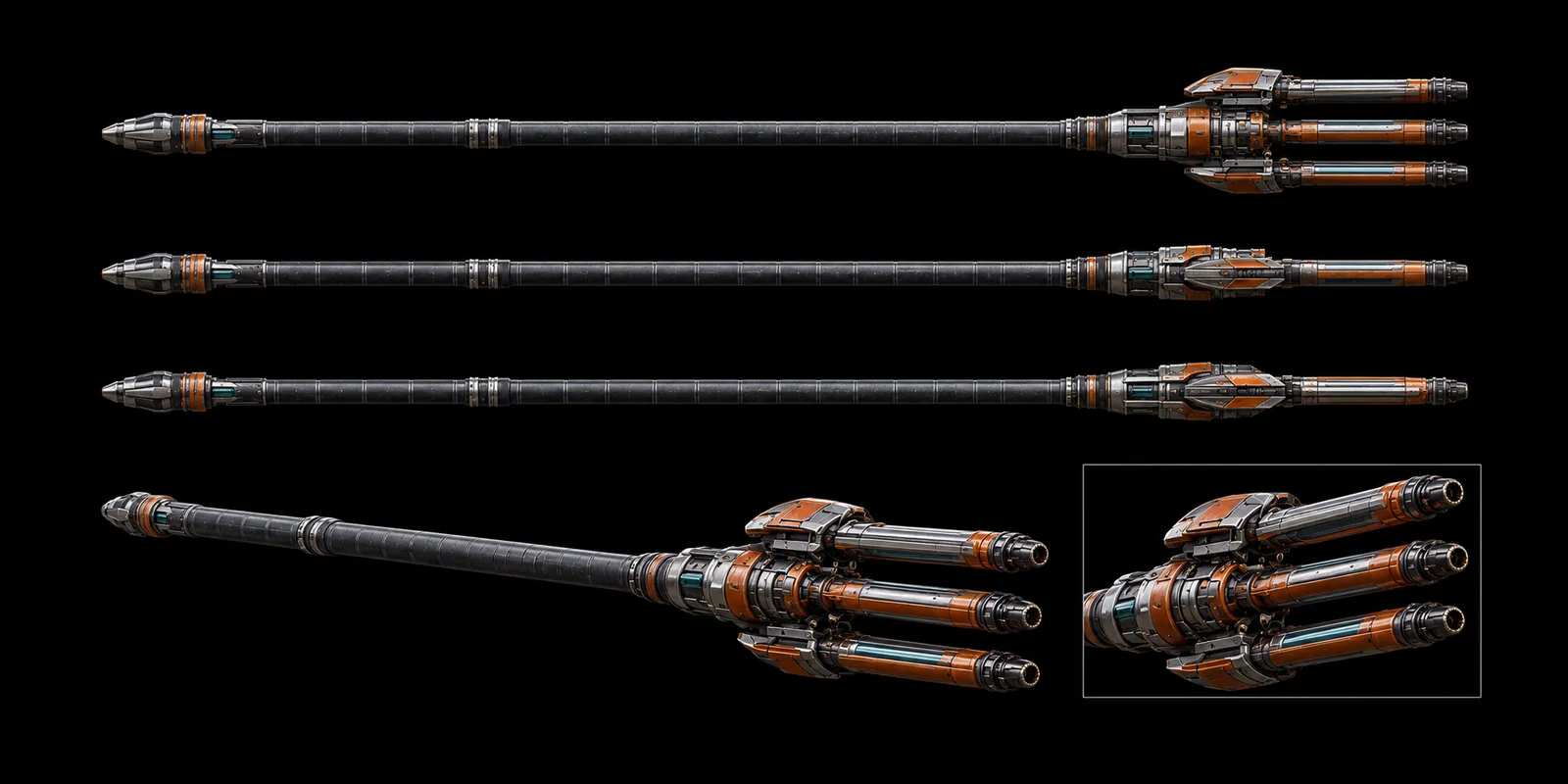
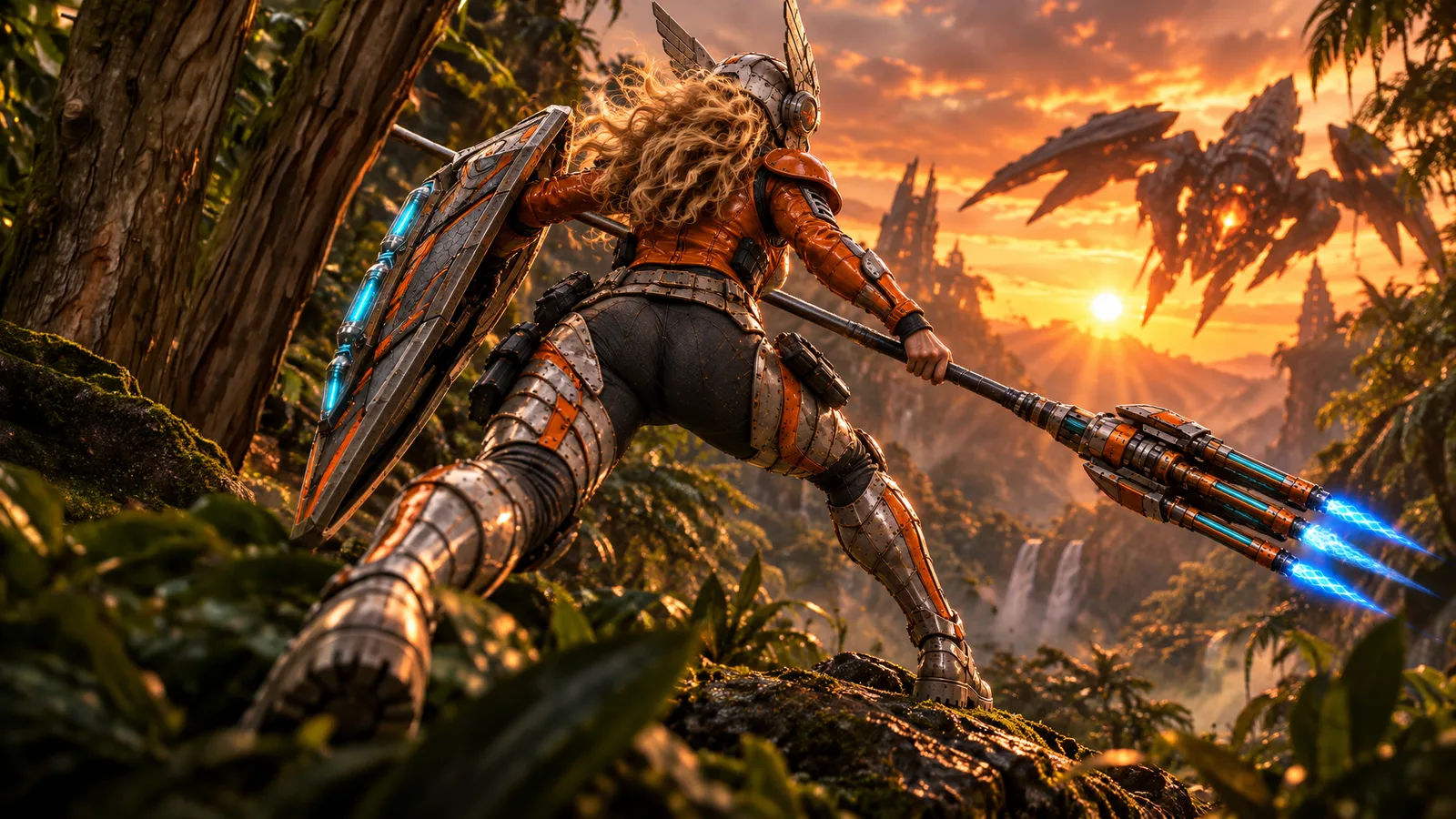
There is a second problem: composition drift. A user asks to replace a helmet, and the model also modifies the face, hairstyle, viewpoint, lighting, or anatomy. This matters because the purpose of the operation is not to make a different attractive picture. It is to make a specific edit to a picture that already works. Even a new image that looks more spectacular can be a failed replacement if it loses the original composition.
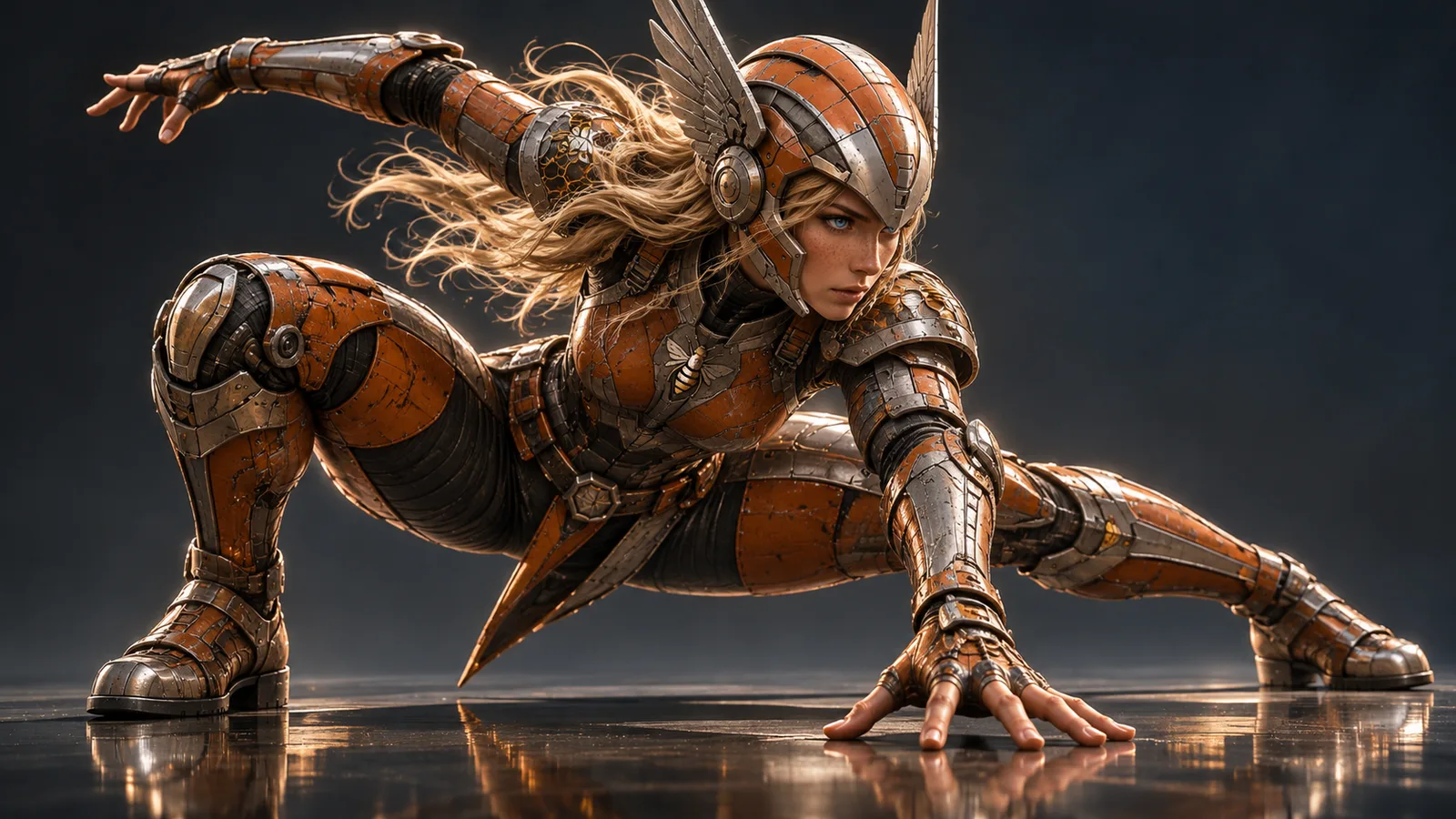
And then there is the matter of style. My series shifts between photorealism and comic-book illustration. A stylized replacement must inherit the original image’s line weight, hatching, local contrast, and color relationships. A realistic chrome prop dropped into a flat cel-shaded drawing can feel as foreign as a photograph pasted into a woodcut. The design must remain the same while the means of depiction change. I’m still learning how to navigate between these stylistic needs.
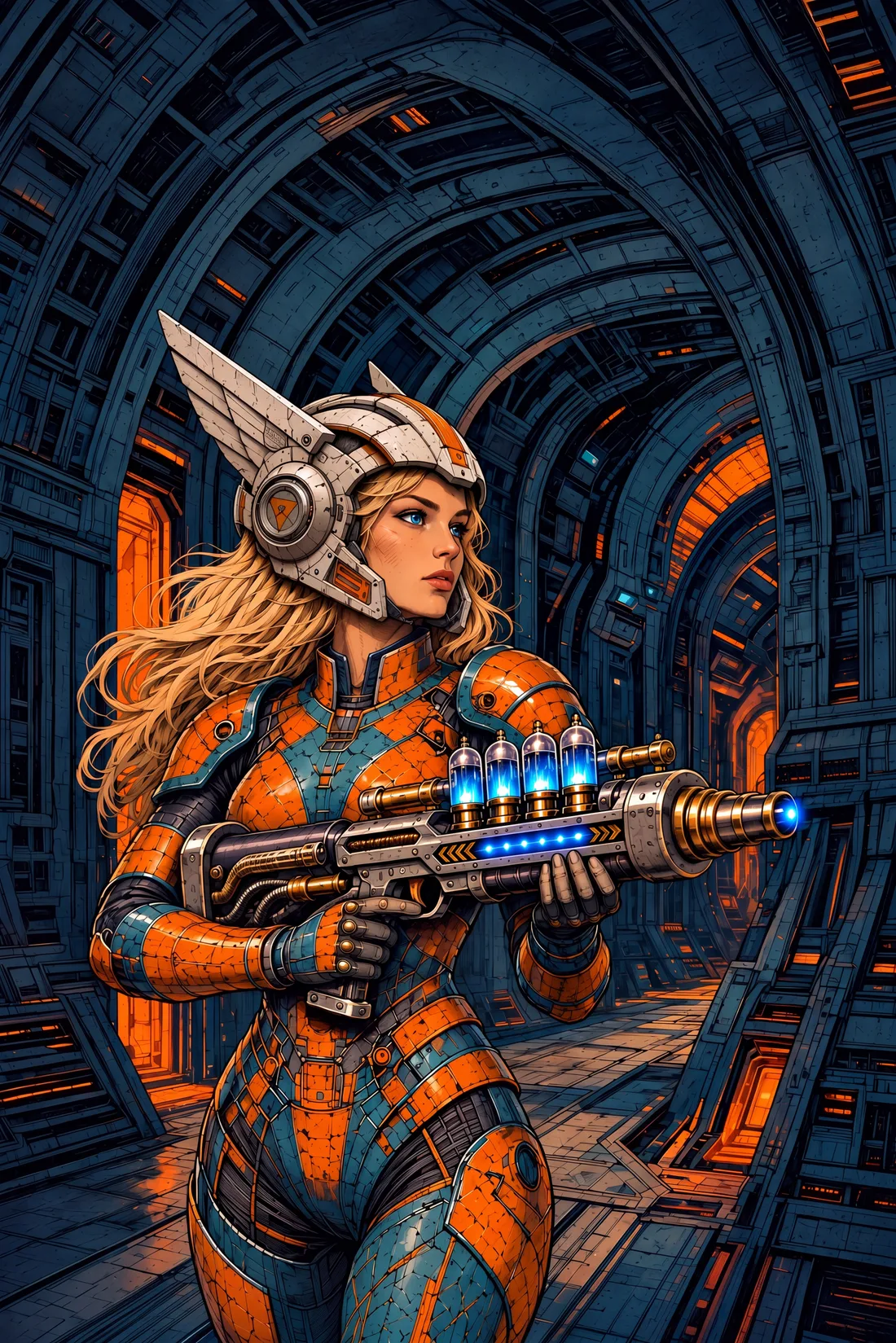
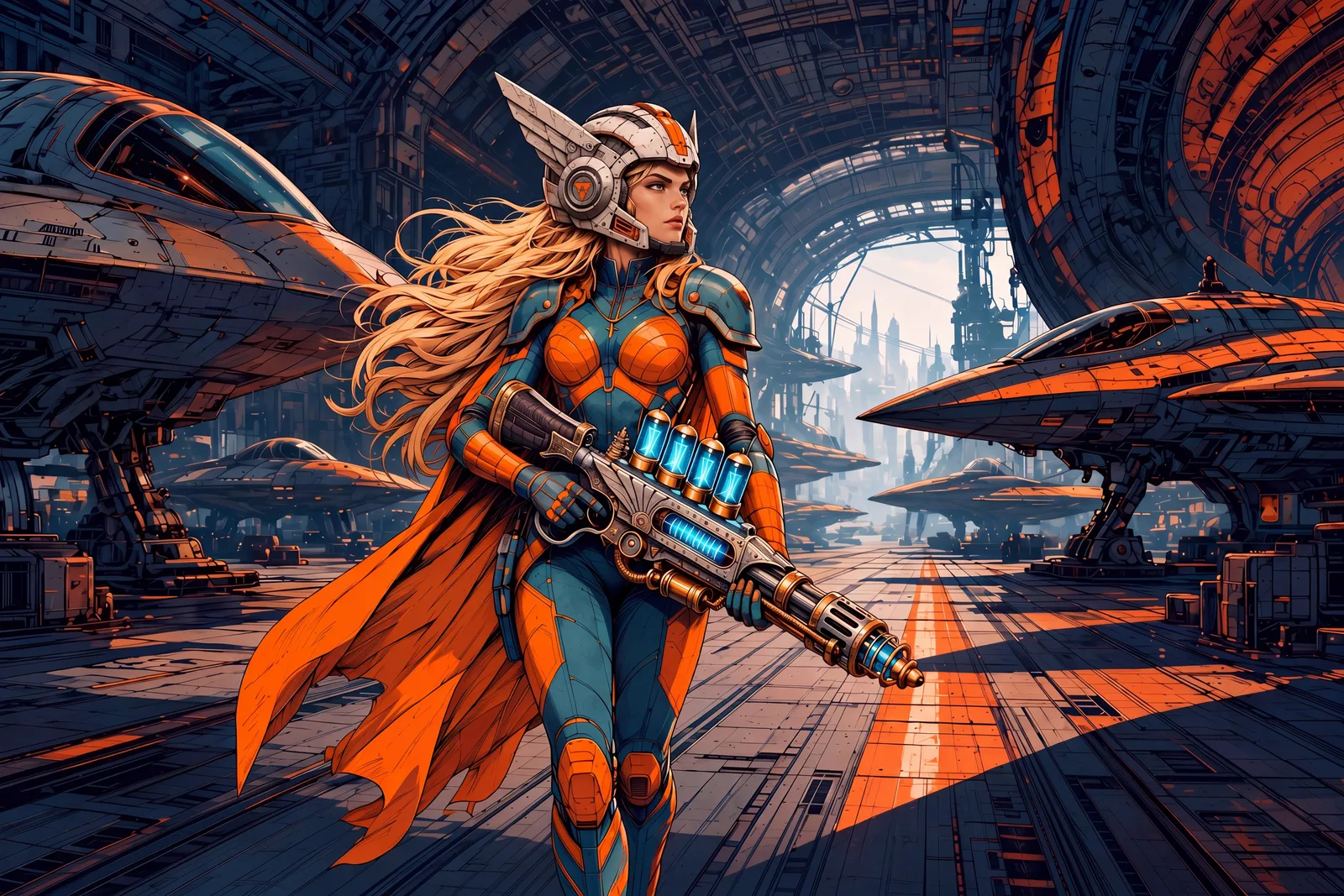
A small production pipeline for an independent artist
A solo artist can borrow some discipline from studios without borrowing their complexity. I’d begin by making a canonical asset sheet, not just a hero rendering. Give the prop a clear silhouette, a series of mutually consistent views, and several close-ups of details that must survive. Record its colors and materials, but don’t confuse a color palette with geometry. A rifle’s shape is still recognizable in grayscale; its blue lamps alone cannot carry its identity.
Next, distinguish locked features from editable features. For the blue-tuber, I would lock the number and arrangement of vacuum tubes, the receiver proportions, the grip, stock, light array, and muzzle geometry. Scene-dependent attributes such as reflections, scratches, atmospheric haze, and the intensity of the glow can vary. For the VT-7 helmet, the wing shapes, circular ear mechanisms, face opening, and cheek guards should remain consistent while the lighting and linework adapt to the scene.
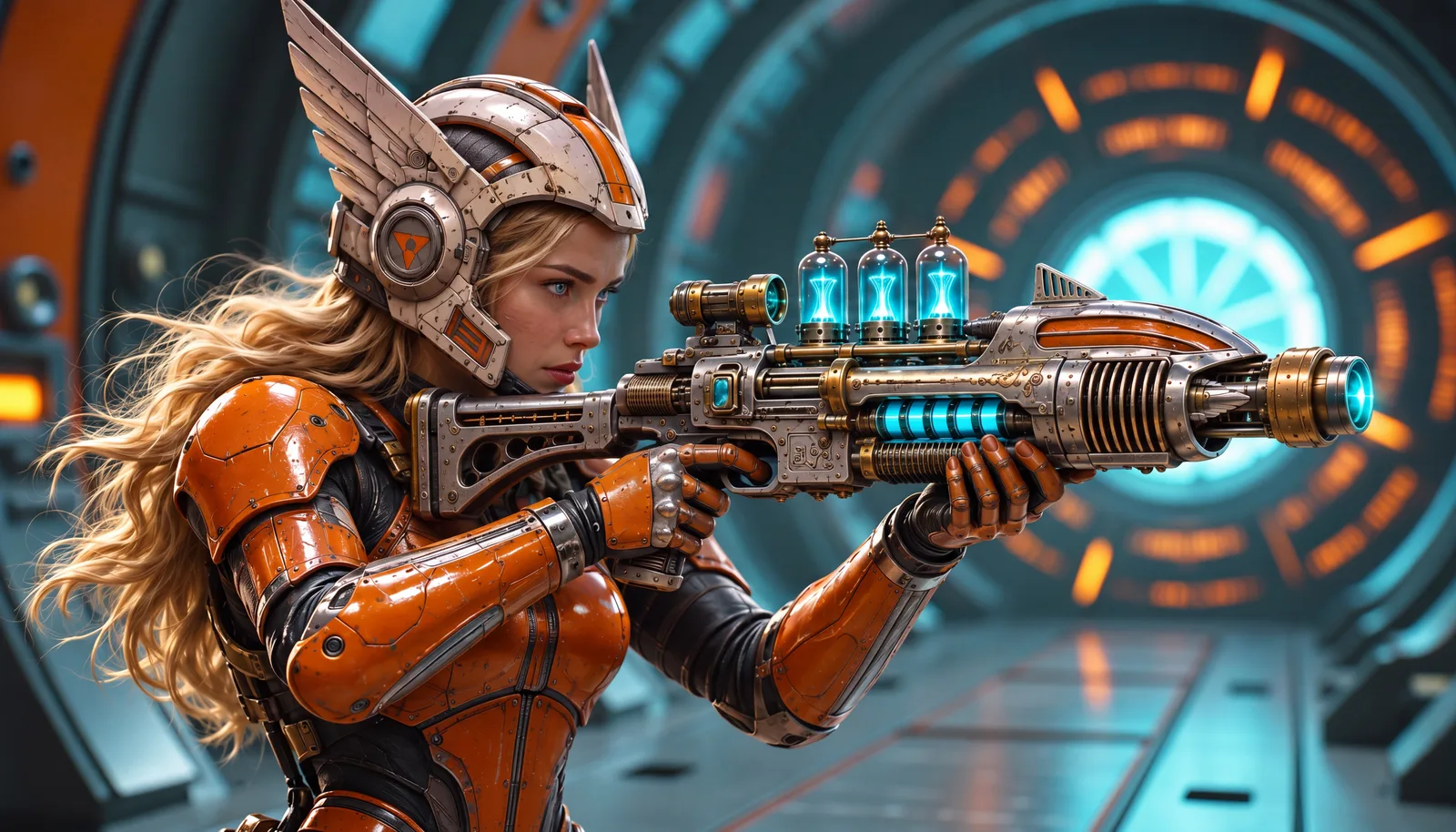
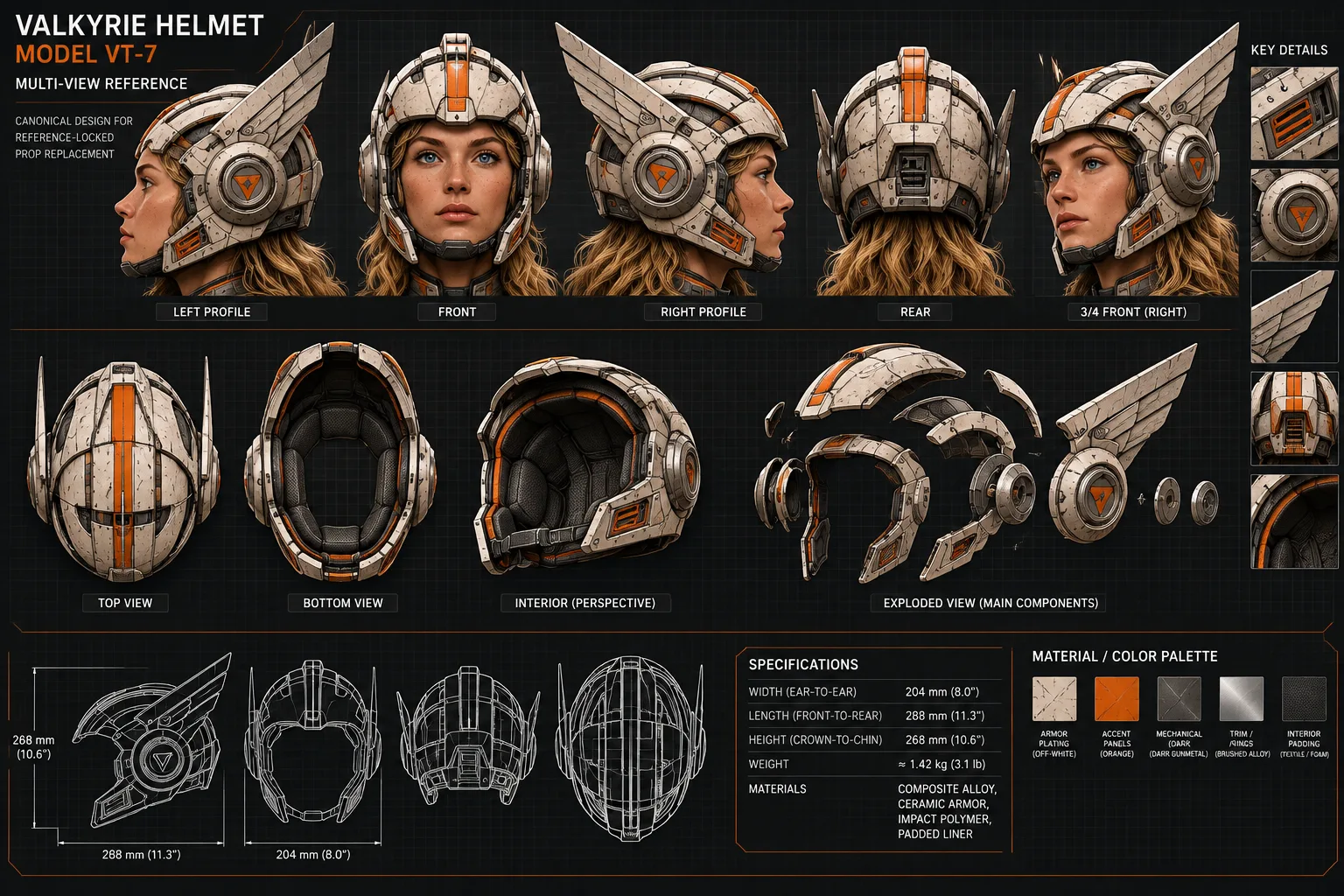
Then preserve a copy of the unedited image and use that as the source for each new attempt. Supply the canonical reference alongside it. Describe the intended edit in operational language: change this region, match this orientation, preserve the camera, preserve the anatomy, preserve the background. Where the tool offers masks, use them. Where it offers only whole-image generation, expect a greater risk of unrelated changes and inspect accordingly. When the hands intersect the prop, allow small, local anatomical corrections rather than forcing an impossible grip.
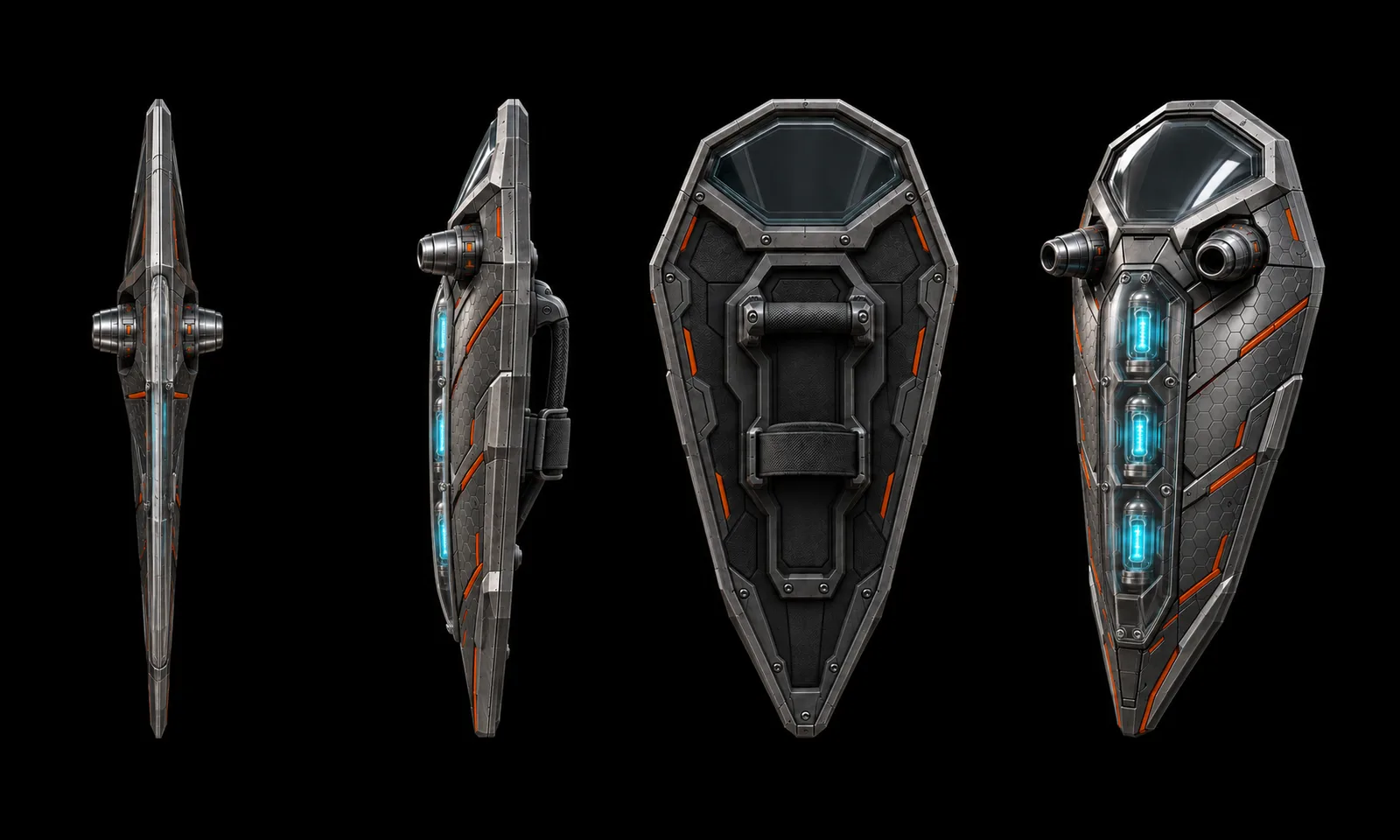
Finally, compare the output with both sources. The new image must pass two separate tests: Does the replacement still look like the approved asset? And did the rest of the picture remain what I intended? I find it helpful to check the silhouette first, because decorative detail can disguise substantial changes in proportion. The second check should cover composition, face, pose, and any nearby object that could have been inadvertently regenerated.
An especially useful exercise for students would be to perform the same replacement three ways: first with ordinary Photoshop compositing, then with masked inpainting, and finally with a more open-ended generative edit. Compare the time spent, which pixels changed, how the hands interact with the prop, and whether the object still matches its reference. You will learn as much from the failures as from the successes.
A style grammar for the whole world
Everything above is about keeping several props and costumes consistent. But the rifle and the helmet are not isolated designs; they belong to a civilization, and that civilization needed its own grammar before any single object inside it could make sense. I call the result Sacred Hive Retro-Futurism: a design language that fuses 1930s-to-1970s Art Deco industrial engineering and raygun gothic technology with monumental sacred architecture and the geometric logic of honeybee biology. Hexagonal honeycomb geometry, concentric circles, rounded rectangular panels, generous corner radii, and aerodynamic curves are meant to recur at every scale, from a starship hull down to a single rivet pattern, so that a floor grate and a spacecraft read as products of the same culture. Materials carry their own logic too: brushed aluminum and gunmetal establish structure, brass and copper mark refinement or ceremonial importance, and a restrained secondary palette of teal and warm orange does most of the lighting, with bright cyan held in reserve for anything specifically meant to read as energized.
The full prompt for that world runs long, so in practice I lean on five shorter rules to keep myself honest from one generation to the next. Geometry is cultural identity: the hexagons, circles, and radiused rectangles have to keep showing up, because their repetition is what makes unrelated objects look related. Function precedes ornament: a hexagonal grate should be venting something, and a brass ring should be reinforcing a joint, since the sacred geometry is supposed to emerge from engineering rather than sit on top of it as decoration. Materials communicate hierarchy, so steel and aluminum read as structural while brass, copper, and gold signal refinement or ceremony. Light creates cohesion, which is why the teal-and-orange palette stays constant even as a scene’s content changes. And the hive is a worldview rather than a decoration, so its influence should shape how things are built and organized, not just show up as an emblem stamped onto a shoulder pad.
Thinking along these lines keeps introducing me to old and new ideas alike, which is probably why I keep coming back to it. I’ve been charmed by Art Deco since long before I knew it was a movement with a name and a history. Bees, science fiction, and the old image of Valkyrie maidens choosing the worthy have all stayed with me in one form or another for years; I’d already borrowed the Valkyrie idea once before, for an entirely different object, the Valkyrie Superguitar™. None of these interests arrived together on purpose. What keeps me at this for hours is less the technical exercise of locking a rifle’s geometry than the pleasure of discovering how many of these old fascinations can be made to agree with each other inside one invented culture. Chasing down where Art Deco factories, honeybee architecture, raygun gothic hardware, and old myth actually overlap is reliably the thing that gets my mind into flow. And somewhere along the way I got turned on to AI and found a way to use it as a form of recreation. New technology, but an old habit of wanting to unify things.
This is the same locking exercise as the model sheets, just scaled up: instead of asking whether a single rifle survived a regeneration, I am asking whether an entire set of generations still belongs to the same place. A result can be more dramatic, better lit, more impressive, and still fail if it drifts outside this grammar — too much ornament without function, a palette that strays from teal and orange, a bee emblem with no hive logic behind it. The discipline is identical. Only the unit being protected has grown from an object to a world.
The student question: what are we actually learning?
This is not merely a discussion about software efficiency. It raises questions about observation, authorship, and the way a designer learns to see.
A strong reference sheet forces choices that a single seductive illustration can conceal. Where does the helmet’s wing attach? What is its thickness from above? Does the rifle’s stock agree with its grip and receiver? Does the object retain its silhouette when turned around? The inability of an AI model to answer those questions consistently can expose ambiguities in the original design. That is useful feedback, provided the artist treats it critically rather than accepting every variation as an improvement.
There is also a valuable distinction between iteration and accidental revision. A conscious redesign asks whether a different shape improves the idea. Accidental drift changes the object without deciding to. Both can produce beautiful images, but only one is an intentional design process. The remedy is not to suppress experimentation. It is to keep exploration separate from production assets, so that a newly discovered possibility can be evaluated before becoming canon. My hard drives are filling up with accidental revisions!
This way of working also encourages a different understanding of originality. The compositors of the optical era, the animators using model sheets, and the modern artists maintaining digital asset libraries all participate in an artistic process where invention and consistency have to coexist. The work is not less creative because some elements are fixed. In fact, a stable vocabulary can make bolder compositions possible because the artist is no longer reinventing the world with every scene.
I’ve become increasingly interested in the art of subtraction in creative work: deciding which variables not to change. If the helmet and rifle are settled, I can devote my attention to pose, atmosphere, storytelling, and the strange architecture surrounding the character. A constraint becomes a way of concentrating invention rather than diminishing it.
There is even a historical irony here. Animation studios once invented elaborate processes to stop different human artists from drawing the same character differently. A century later, independent artists are finding themselves inventing comparable controls to stop image models from inventing a new rifle every time they are asked to change an old one.
The bigger picture
Reference-guided prop replacement sits at the intersection of several traditions: matte painting, optical printing, digital compositing, model-sheet discipline, 3D asset reuse, and generative image editing. It is not one technology, and it should not be treated as if an AI prompt had suddenly invented the need for visual continuity. Its novelty lies in how cheaply and quickly a single creator can now attempt work that once required more specialized tools and labor.
The ideal goal is not unlimited mutability. It is controlled mutability: the ability to change precisely what the artist intends while retaining everything the artist has already decided. Good images often emerge from discovering new possibilities. Good production design also depends on knowing when an object has become itself.
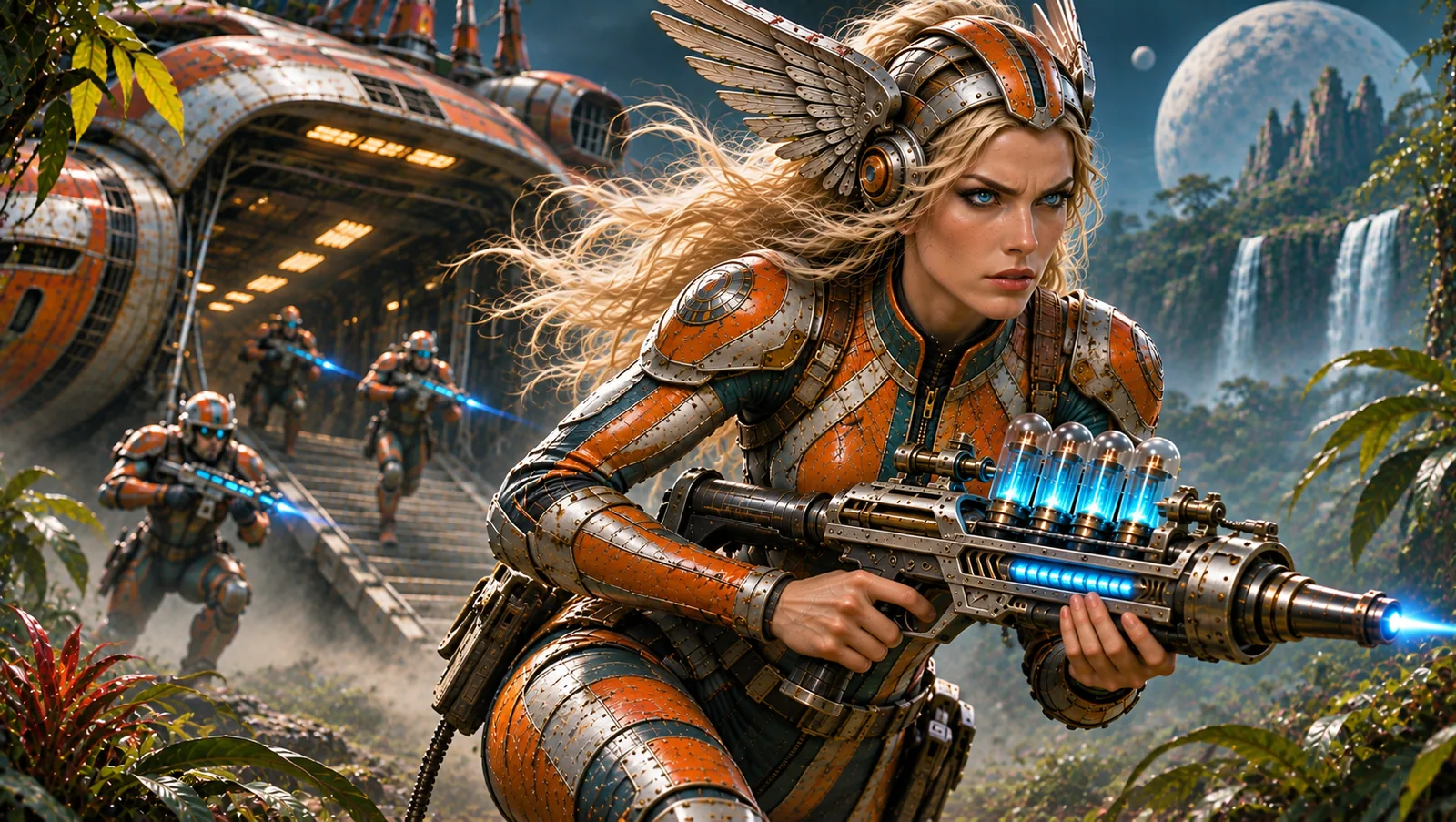
My blue-tuber can appear in a jungle, an industrial corridor, a starship hangar, or a comic-book skyline. It can be painted with cross-hatching or lit like a photographic prop. But if I have to count its vacuum tubes again every time, I haven’t quite solved the problem yet. The struggle is real, as they say.
Here is some of that range, grouped by setting rather than by when I made each one, which is closer to how I actually think about the series.
Jungle.
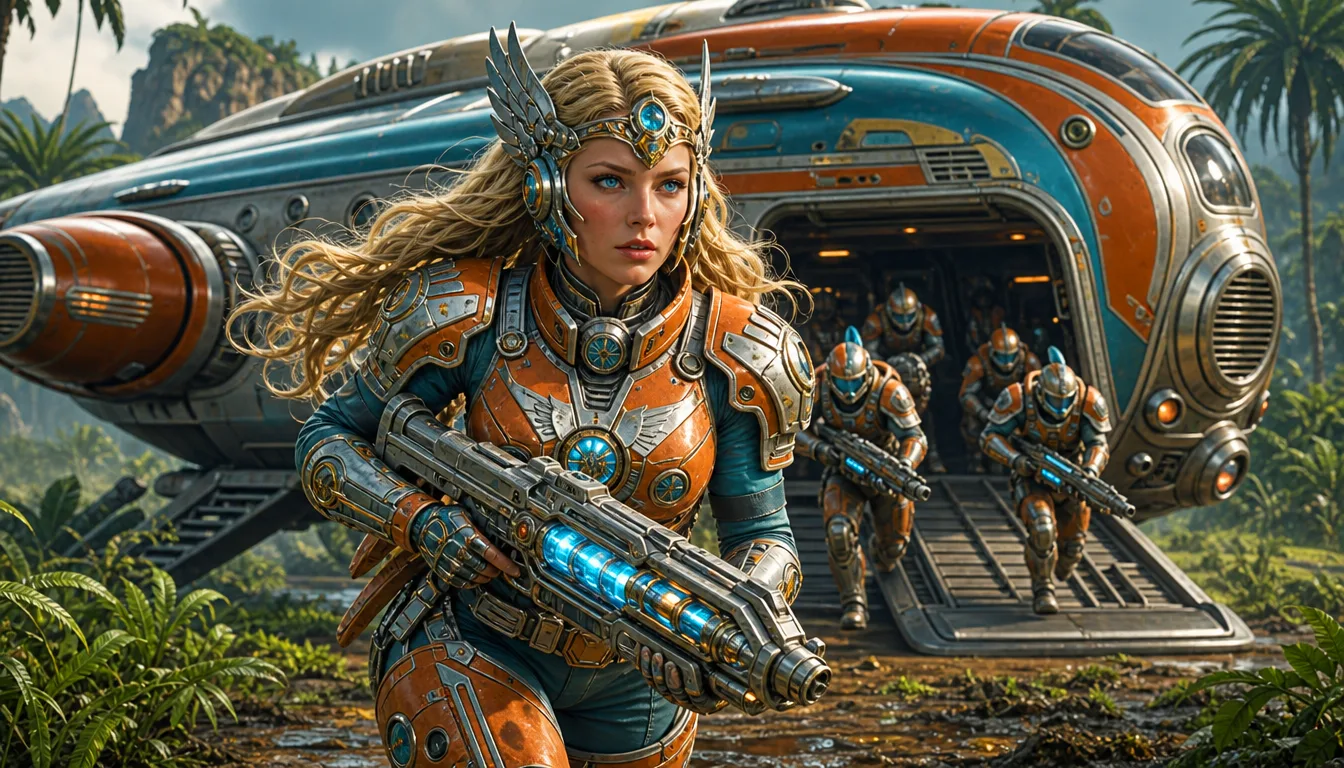
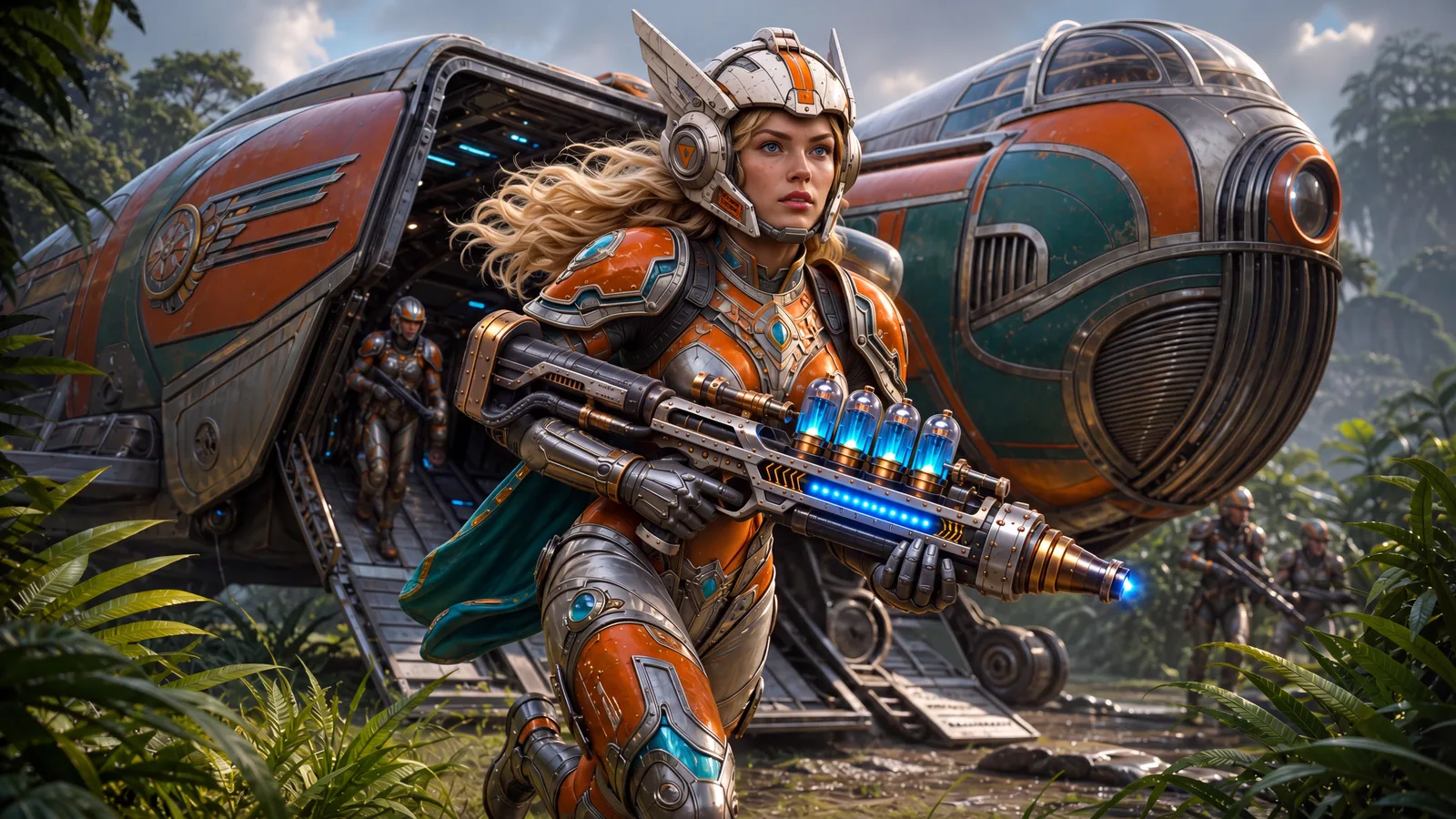
Industrial corridors and the starship hangar.
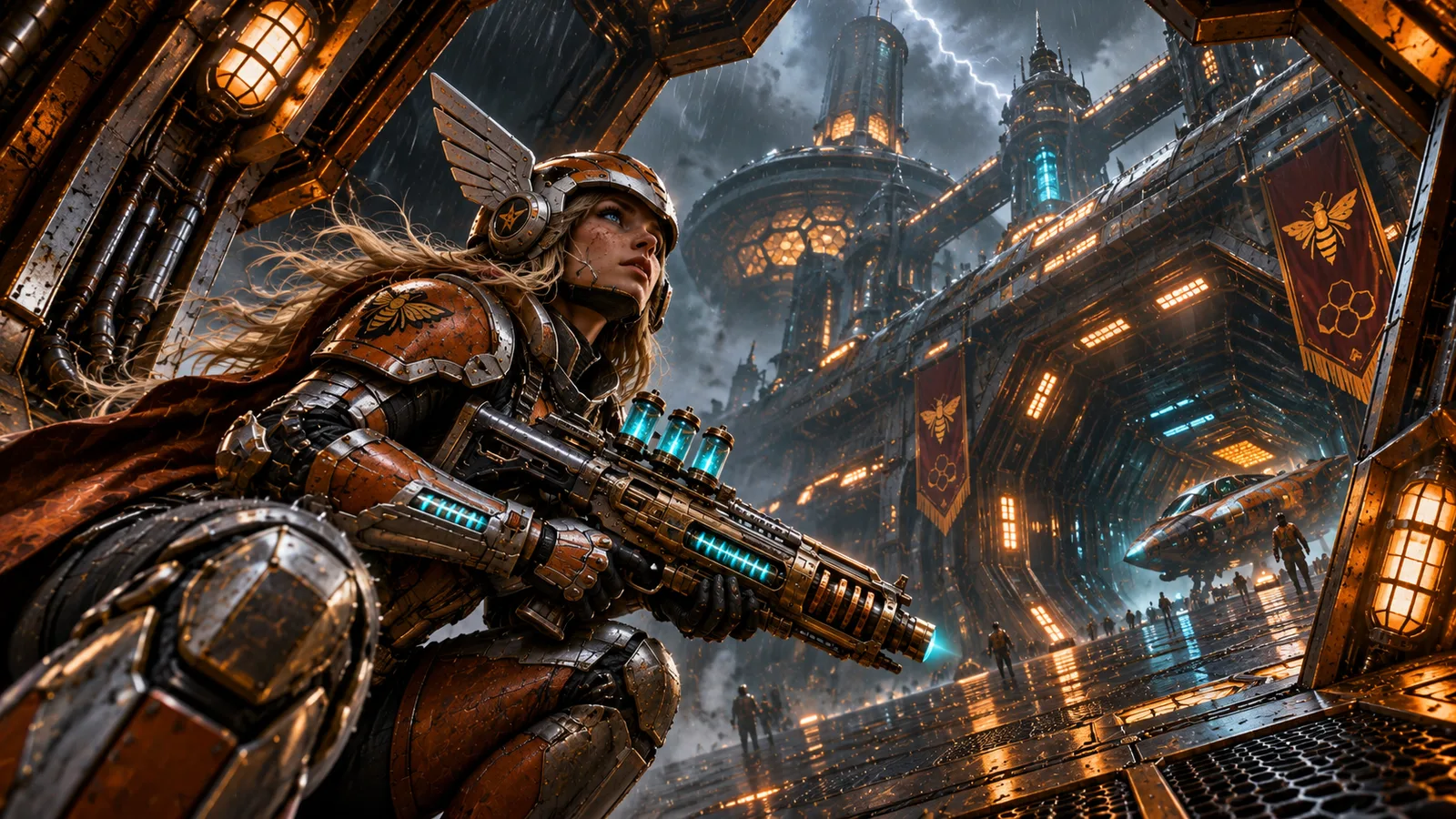
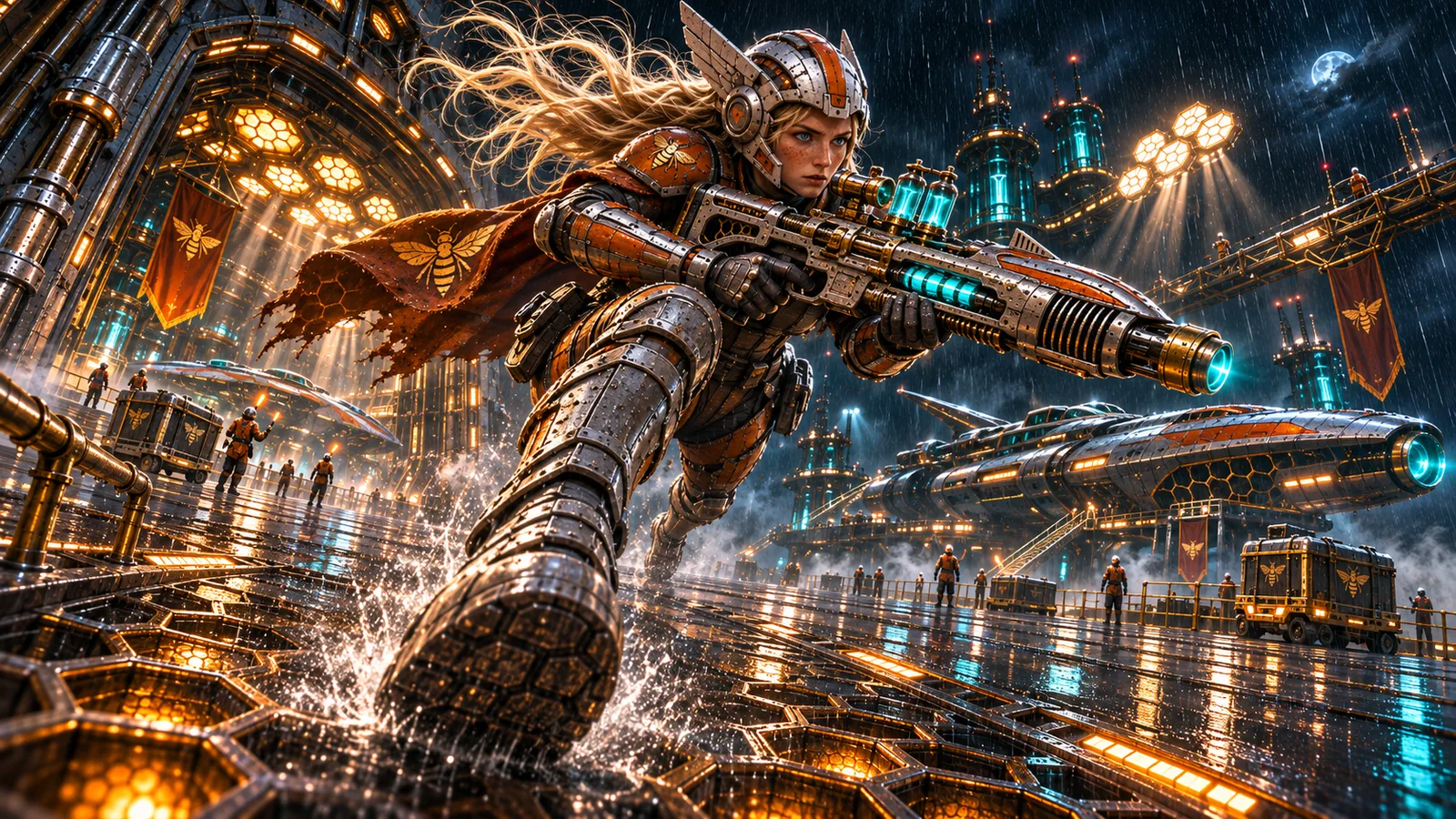
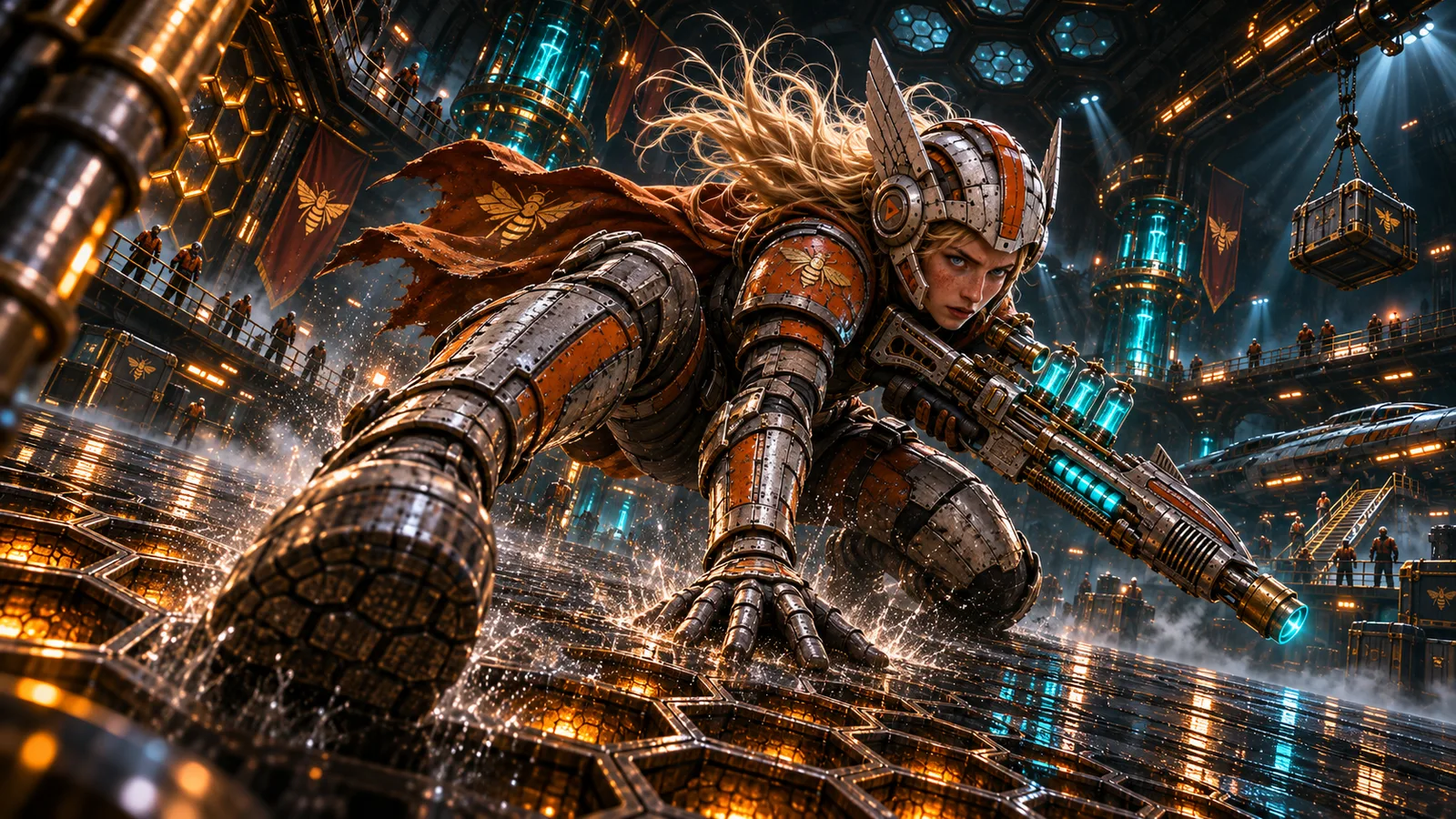
Night and ruins, for a comic-book skyline.
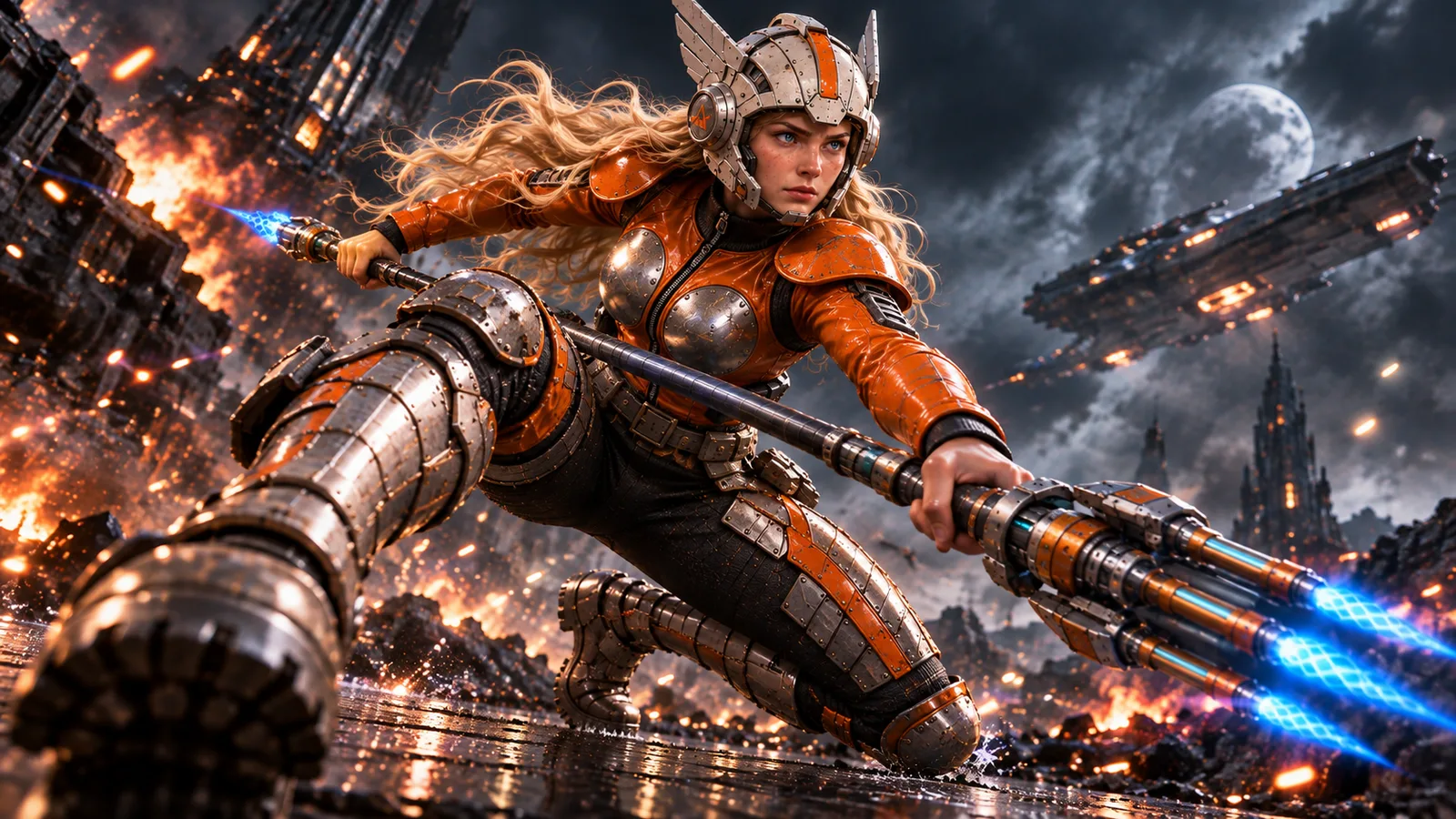
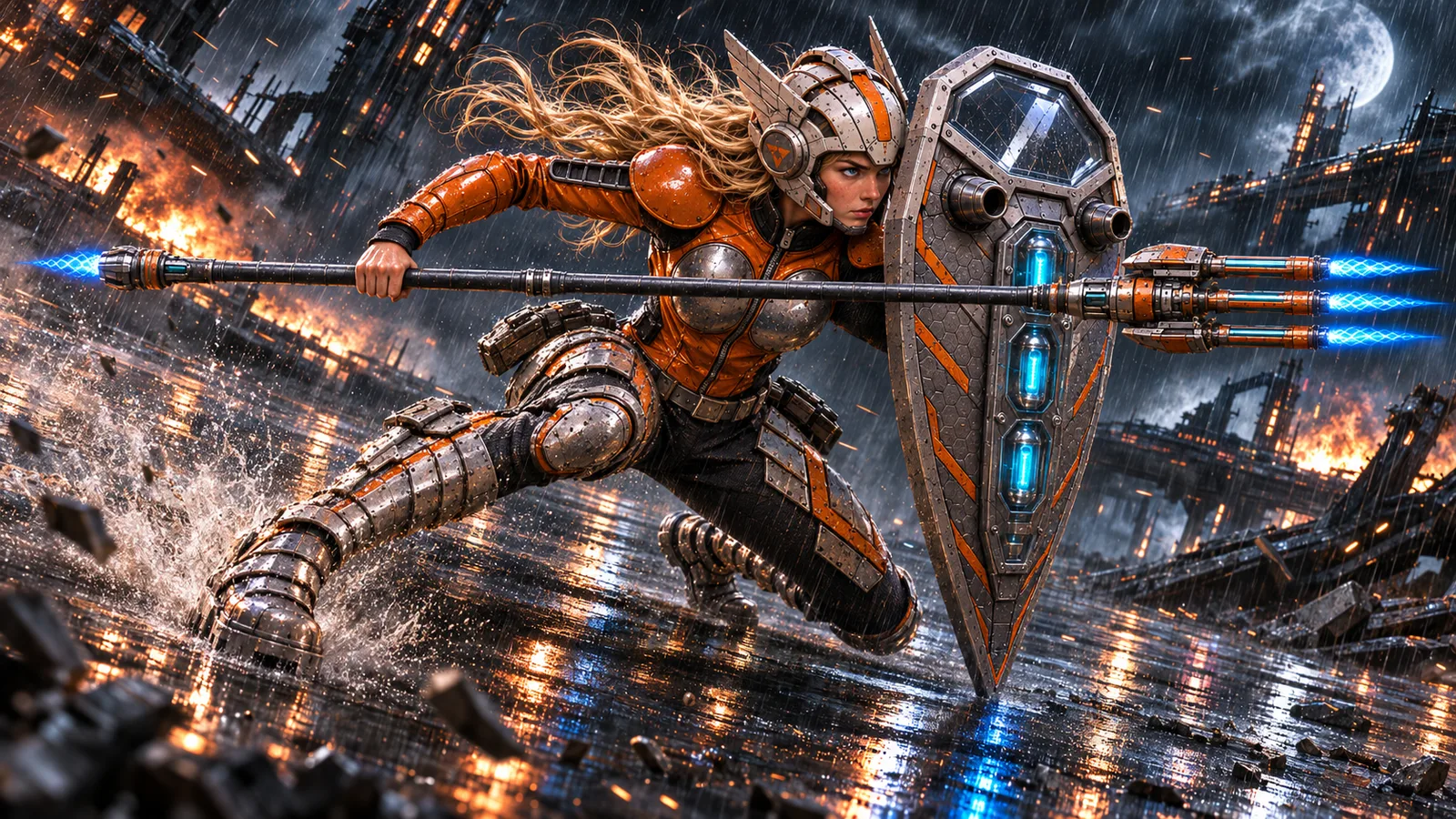
And that, perhaps, is the clearest lesson for any student of digital art: consistency is not the enemy of imagination. It is one of the things that allows imagination to build a world.